Thursday, January 13, 2011

The Tweets Are All Right

Those of you who aren't familiar with my Twitter account — or with Twitter at all for that matter — then you're missing out! I say this because it may help in gaining understanding of some of the grades on the sidebar, especially since some of my opinions are at fierce odds with the critical majority. Within 48 hours of seeing a film I usually grade it and provide a little 140-character summary tweet, although some 2010 features are without one, either because a) I only really started to do them in the summer or b) I simply forgot about it.

There isn't a summary of "Scott Pilgrim vs. the World", which probably best represents my relative hatred for a film that was universally acclaimed. Therefore, let me take the opportunity to say that listing someone's attributes and weaknesses to bypass characterisation doesn't sit very well with me. (Consider that a summary if you wish - I count it as 141 characters if you start from "let".)

In any case, here are my original within-48-hours reactions to the films, some of which (in terms of qualitative assessment) have altered slightly.

"127 Hours," C+ : Thank God I knew that bottle of Gatorade was in the back of the van. Pedantic doesn't ever cover it. Boyle needs HELP.

"The American," B : Somewhat plods through familiar terrain, but tight characterisation and gorgeous craftsmanship win out.

"Animal Kingdom," B+ : Ruminative thriller about murky moral consciences that evades cliché and indulgence in hero. Mendelsohn is King.

"Another Year," B: Pacing issues and a couple of dodgy characters mar this depiction of people punished for rejecting old-age.

"Buried," C– : Tagline should be Cellular-esque: "If the signal dies, so does he". Cortes concocts, attacking everything in sight.

"The Disappearance of Alice Creed," C : Just how many stupid women did Gemma Arterton play this year? Gutsy but convoluted, absurd trash.
[Downgraded to C– upon reflection]

"Essential Killing," C : A promising start wasted when it becomes clear that this is little more than an exercise in degradation. Stingy business.
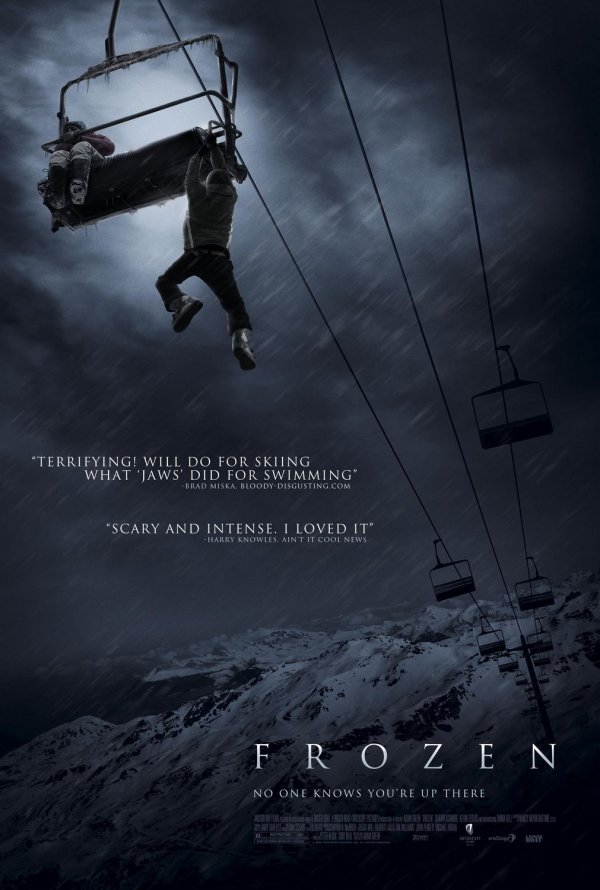
"Frozen," B– : Inconsistent, but quietly astute, riveting stuff. I want to marry Shawn Ashmore.

"Get Low," C– : Schneider doesn't have a clue how to implement backstory. Dour, unassumingly trite lament of old-age.

"The King's Speech," C : Couldn't the BBC have knocked this up for a sliver of the budget? Droll, drawn out, merciless storm in a teacup.

"Last Train Home," B+ : Narrative too orchestrated, but it's a harrowing portrait of poverty. Benefits from Fan's intrusive style.

"Monsters," B– :Meditative with themes rather than manic; achieves poignancy, but not in the way it most wants to. Beautiful, though.

"The Refuge," B– : Guiltily downgraded. Moments of tenderness & character obfuscation stir, but is it an easy way out? Carre wows.

"Restrepo," B– : Conceals sparseness of footage through interview overkill, but it's organically made; candid even.

"Secretariat," C : Stirs emotions, but mainly through seeping sentiment out of every pore. Like the horse, gets better as it goes.

"The Social Network," B+ : Brisk roundabout style works well, and it's not SO determinate. Jesse, Andy impress; flaming trash cans don't.

"Splice," C– : Artificially novel, bizzarely trite. Interesting for a time, but clichéd, and handles Brody character all wrong.

"The Tourist," D : Drags an underdeveloped plot through 95 mins; gives Depp and Jolie horribly 2D characters to sell. They don't. Dire.

"Unstoppable," B : Its star duo aren't that believable, and the token subplots are annoying, but it's SUCH a showstopper. Awesome.
[Upgraded to B+ upon reflection]

"Wild Target," C : Proof that continental humour is difficult to replicate. Blunt is appealing, but it's largely absurd and lax.
[Downgraded to C– upon reflection]


Of course, if you have me on Twitter you'll probably have read these already.

2010 Golden Globe Predictions

My predictions for the Golden Globes, this coming Sunday:

Best Motion Picture, Drama

Black Swan
The Fighter
Inception
The King’s Speech
The Social Network

Prediction: The Social Network

Best Director - Motion Picture

Darren Aronofsky, Black Swan
David Fincher, The Social Network
Tom Hooper, The King's Speech
Christopher Nolan, Inception
David O. Russell, The Fighter

Prediction: Darren Aronofsky, Black Swan

Best Motion Picture, Comedy or Musical

Alice in Wonderland
Burlesque
The Kids Are All Right
Red
The Tourist

Prediction: The Kids Are All Right


Best Actor in a Motion Picture, Comedy

Johnny Depp, Alice in Wonderland
Johnny Depp, The Tourist
Paul Giamatti, Barney's Version
Jake Gyllenhaal, Love and Other Drugs
Kevin Spacey, Casino Jack

Prediction: Johnny Depp, Alice in Wonderland

Best Actor in a Motion Picture, Drama

Jesse Eisenberg, The Social Network
Colin Firth, The King's Speech
James Franco, 127 Hours
Ryan Gosling, Blue Valentine
Mark Wahlberg, The Fighter


Prediction: Colin Firth, The King's Speech


Best Actress in a Motion Picture, Drama


Halle Berry, Frankie and Alice
Nicole Kidman, Rabbit Hole
Jennifer Lawrence, Winter's Bone
Natalie Portman, Black Swan
Michelle Williams, Blue Valentine

Prediction: Natalie Portman, Black Swan

Best Actress in a Motion Picture, Comedy


Annette Bening, The Kids Are All Right
Anne Hathaway, Love and Other Drugs
Angelina Jolie, The Tourist
Julianne Moore, The Kids Are All Right
Emma Stone, Easy A

Prediction: Annette Bening, The Kids Are All Right


Best Supporting Actor in a Motion Picture

Christian Bale, The Fighter
Michael Douglas, Wall Street: Money Never Sleeps
Andrew Garfield, The Social Network
Jeremy Renner, The Town
Geoffrey Rush, The King's Speech

Prediction: Christian Bale, The Fighter

Best Supporting Actress in a Motion Picture

Amy Adams, The Fighter
Helena Bonham Carter, The King's Speech
Mila Kunis, Black Swan
Melissa Leo, The Fighter
Jacki Weaver, Animal Kingdom

Prediction: Amy Adams, The Fighter

Best Screenplay - Motion Picture

127 Hours
The Kids Are All Right
The King's Speech
The Social Network
Inception

Prediction: The Social Network


Best Original Song

“You Haven’t Seen The Last of Me,” Burlesque
“Bound To You,” Burlesque
“Coming Home," Country Strong
“I See The Light,” Tangled
“There’s a Place For Us,” Voyage of the Dawn Treader

Prediction: “You Haven’t Seen The Last of Me,” Burlesque


Best Original Score

Alexandre Desplat, The King's Speech
Danny Elfman, Alice in Wonderland
A.R. Rahmin, 127 Hours
Trent Reznor, Atticus Ross, The Social Network
Hans Zimmer, Inception

Prediction: Hans Zimmer, Inception


Best Animated Feature Film

Despicable Me
How to Train Your Dragon
The Illusionist
Toy Story 3
Tangled

Prediction: Toy Story 3


Best Foreign Language Film

Biutiful (Spain/Mexico)
The Concert (France)
The Edge (Russia)
I Am Love (Italy)
In a Better World (Denmark)

Prediction: I Am Love (Italy)

Wednesday, January 12, 2011

Bitesize Best Actress Oscar Profiles: Merle Oberon

Merle Oberon in "The Dark Angel"
Lost the 1935 Best Actress Oscar to Bette Davis in "Dangerous"

Grade: **

For a film about jealousy, angst, and love triangles "The Dark Angel" is awfully pallid, conjuring problems for its billed trio in the vein of miserablist melodrama. The first half of "The Dark Angel" spans years and yet we only encounter four characters: Merle Oberon's Kitty, Fredric March's Alan, Herbert Marshall's Gerald, and Gerald's mother, Mrs. Shannon.

One of the main issues for Oberon is founded upon the film's insistence on flitting back and forth between Kitty's romances with Alan and Gerald, neither of which is very interesting or reveals much about the two men. As the romantic core of the film Oberon's role is buried somewhat underneath the melodrama, the dramatic aims of the narrative providing scant opportunity for her to do anything but react to Kitty's dearth of fortune. She often endeavours to do this through impulsively pained gestures of emotional intensity, and her lucid, harsh vocal work distracts from the implied tenderness of the romantic exchanges. Either as a result of the constraints of concentrated melodrama, or because she simply doesn't know what the character is supposed to represent, Oberon is unable to create much of a transitory impression of Kitty, reliably pleasant but fatefully languid a heroine for much of "The Dark Angel"'s testing length.

She does, however, nail the film's final scene (possibly its finest), gladly festering on a rare-afforded opportunity to independently shine. Kitty's feelings, completely unanchored and fragile as she is deceived by her original first love Alan, allow Oberon to explore this woman a little deeper, to investigate the harsh emotional ambiguities that have entered this wispy (for a while, anyway) dilemna of love. Oberon really pushes the reserved character to desperate levels of solemn, impacting frustration, and without over-exerting herself anywhere near as rashly as she does in the film's middle portion.

And yet, you never really get a sense of who Kitty is; whether she is content because she knows she has a husband in the bag, or if she is just a placid introvert biding her time. Oberon doesn't develop enough through the hurdles of the character, and fails to allude to her internal conflict, neither seeming resilient or resigned to life passing her by. Disappointingly, for long spells of "The Dark Angel", the footholds of the script bypass Oberon too. 

Sunday, January 09, 2011

Anika Noni Rose in For Colored Girls

This post is especially for Stinkylulu's Supporting Actress Smackdown - The Class of 2010, which reaches its 5th year of existence and long may it continue.


While watching Tyler Perry’s “For Colored Girls” (Who Have Considered Suicide When the Rainbow is Enough) it’s impossible not to marvel at the film’s excellent assemblage of actresses. Whether it’s the legendary attitude of Whoopi Goldberg, the showy tendencies of Thandie Newton, the stern wisdom of Phylicia Rashad, the continually undervalued talent of Loretta Devine, Kerry Washington and Kimberley Elise, or the welcome contribution of relative newcomers Tessa Thompson and Macy Gray, everybody has a hand in carrying the novel’s wrenching emotion into a powerful cinematic experience.

The main difficulty for “For Colored Girls” is that it’s so issue-driven — with seven definitive characters that all interlink in some way — that it often translates as extremely contrived. Although the women themselves feel like realistic representations of the African-American female, the shifting focus of the film offers little time to build a sense of who they are beyond victims. They’re burdened by issues of rape, abuse, jealousy, pregnancy, infertility, but I don’t think Perry does enough to allude to how the women have got to this position, and the production takes on a bit of a Serial Drama structure. That being said, the acting is certainly the biggest success of the film, and one can imagine this turning out disastrously were the seven principal figures not so eminently watchable on-screen.

I have decided to focus on the performance which most affected me, and which sidesteps the constraints of heavy-handed plot elements with enviable ease:


*Warning: There are plot spoilers*


Anika Noni Rose is Yasmine (aka Yellow), a cool lady who teaches one of the film’s other “Colored girls” to dance, at an uptown college. She immediately strikes you as one of these people with an easy-going outlook on life, not especially well-off but by no means poor. As she helps Nyla (aka Purple) deal with her own problems she gives the impression that she recognises herself at that age, passionate and rash, and the way that she deals with Nyla reinforces the sense that she’s giving something back to an art that fostered her creative freedom. Yasmine feels completely content to live as she is, prioritising personal happiness over accumulative gain, missing love in her life for sure, but otherwise together, and proud that she has managed to acquit herself in a vocation that she loves.

We meet Yasmine’s suitor Bill as he chases after her one afternoon like a lost puppy, charming and cheeky, plying her with attention as they discuss the possibility of a date. Yasmine feels reluctant at first, and, even though she is a very attractive woman, reveals a possible lack of experience with the dating game, and a hint of bashful self-consciousness. This scene played back might reveal an innate, instinctive tentativeness in Yasmine towards Bill, and he certainly tries too hard to woo her. One often judges a concerted effort as a form of flattery more than an act of desperation or deceit, and in any case, when he invites her to cook him dinner Rose’s coy, confident smile indicates that Yasmine knows that she can make this another one of her success stories.

In the vein of “For Colored Girls” it’s somewhat inevitable to disclose that this date does not end in success, and in the second most harrowing sequence of the film (the first is not even open to debate) Yasmine finds herself in as drastic a predicament as a woman can endure. When the camera zones in on her during this sequence Rose displays such a distraught sense of resignation, and a painful dose of self-deprecating anger at not getting this one right: she should have listened to her instincts. And it carries through to the aftermath of the event, since she's predictably noble enough to report the offence to police officers but guiltily bitter towards her assailant. As Yasmine is required to identify the man’s body later in the film Rose nails a huge confluence of emotion; her unleashing of anger at not being able to confront him on a level footing, and a faint sense of pride at justice winning out. Her attack towards him reads as a natural reaction yet somewhat fearful, as if she is wary of letting her darker emotions take over.

While you’re certain that the film’s “yellow” heroine has never seen darker days, Rose gauges Yasmine’s arc immaculately, and not so drastic as to suggest that she won’t recover. In fact, one imagines that she’ll take this event relatively on-the-chin as she does with every other element of life (she shouldn’t have to, but she will) and put on as brave a face as she always has. Rose makes Yasmine the most genuine character in “For Colored Girls” despite its clamouring sense of finality towards her strand of the narrative. Yellow is the perfect colour for this woman; reliable, resilient and good-natured, sensitive, fragile and resonant. Rose resonates more than any other single element of the film, and provides one of the most valuable and finest performances of the year.

Friday, January 07, 2011

Bitesize Reviews of "Burlesque" & "The Way Back" (2010)

Burlesque
Directed by Steve Antin
Starring: Christina Aguilera, Cher, Stanley Tucci, Cam Gigandet, Kristen Bell
Grade: B -

"Burlesque" will probably be most famous because it should have been awful and actually manages to survive, despite being the brazen, contrived vehicle for Christina Aguilera that one might suspect. It sidesteps a lot of eye-rolls and shaking of heads through being so upfront, bold in its all-guns-blazing approach to, not only the musical showpieces, but the steadfastly-thundering, admittedly modest plotline. Aguilera's Ali, for instance, isn't given an abusive spouse, a mob of gangsters, or some other clichéd reason to escape from her small, gloomy hometown, because there doesn't need to be a demon to evade. Purely and simply: she has talent, and it isn't serving her where she is. Hello the bright lights of L.A., and the Burlesque club run by the formidable Cher, occasionally great in a role that resembles that of a brothel Madam.

Kristen Bell's jealous alcoholic tramp and Cam Gigandet's gratuitously naked barman are very standard representations of the "bitch" and the "boyfriend" respectively, and Eric Dane's sleazy businessman recalls the worst parts of The Devil Wears Prada (i.e. Anne Hathaway's tryst with Simon Baker.) But even as it compartmentalises its peformers, the film shows them on the edge of their abilities, capabilities, existence, and promotes these people in a way that you rarely see anymore. They're often celebrated for their flaws rather than chastised for them, and "Burlesque" ingratiates itself by not taking its characters or their hangups so seriously until it needs to manoeuvre the romance and triumph in the narrative.

"Burlesque" stays afloat mainly because it sells every bit of its premise, enjoyably infatuated with its setting, the theatricality of the art its depicting, and resoundingly fierce about the near-extinct status of the art form in contemporary culture. It's invigorating to see a film with this amount of passion in it.
Not immaterial but forgivable, the flaws of "Burlesque" read as a confession that showcase is the primary concern, and that's a difficult value to begrudge.


The Way Back
Directed by Peter Weir
Starring: Jim Sturgess, Ed Harris, Colin Farrell, Saoirse Ronan
Grade: C+

It isn't really perceptive — or even informative — to divulge that Peter Weir's "The Way Back" is a true story, given the obvious allusion of the film's staunchly-laid sentiment. Chronicling the escape of prisoners in a Soviet POW camp during World War II, the film features familiar archetypes of men drawn together through imposed confinement: the whiter-than-white hero, the wise old owl, and the opportunistic villain. Sturgess, Harris, and Farrell play their roles very well; the modest, careful approach towards the casting perhaps only blighted by an intermittently shaky showing from Ronan.

The problem with "The Way Back" is that the nature of the story isn't a novel one, and the lineated storytelling is desperately short of incisive drama. The journey that the group make across the borders of Russia, Mongolia and Tibet feature perfectly legitimate pitfalls of hunger, thirst, and the struggle against torrid weather and terrain, but these elements aren't enough to sustain much interest. It reads as too faithful to the story, too cloudy when it comes to certain characters, and often feels only concerned with Sturgess's Janusz. With a narrative this traditional it needs to be immersive for the viewer, and "The Way Back" really never gets there, familiar and fatefully plain in expressing humanism.

For all of the faults of Stephen Daldry's The Reader it at least manages to manipulate an already strongly-founded relationship and create an investable arc. "The Way Back" employs similar techniques in its closing act to illicit emotive response: a result that sees it limp across the finish in a marginally more competent manner than its weary protagonists, and almost as aimlessly.

Tuesday, December 21, 2010

A Review of Made in Dagenham (Cole, '10)

Made in Dagenham
Directed by Nigel Cole
Starring: Sally Hawkins, Bob Hoskins, Daniel Mays, Miranda Richardson, Rosamund Pike
Grade: C

Written for InRO:

It probably wasn’t a difficult decision to have Nigel Cole direct “Made in Dagenham,” given that he was an ambassador of female solidarity just seven years ago with the Women’s Institute-based “Calendar Girls.” While that film dealt with contravening expectations of what is ‘proper’ for the elder housewife, ‘Dagenham’ has significantly bigger fish to fry. The women in this latest feature are without the luxury of retirement, knitting, and country fetes, instead burdened by prejudice within the workplace and seeking to overturn gender inequality at the Ford Factory they share with male colleagues. Many of these colleagues are related to the women, who are a little miffed to learn that their employment classification has been downgraded from “skilled” to “unskilled.” When union representative Albert Passingham (Bob Hoskins) looks for a female rep-recruit for their next meeting with company executives, the women put good girl Rita O’Grady (Sally Hawkins) forward to fight in their corner. Rita surprises by demanding a one-day staff walkout at the meeting, and proceeds to instigate indefinite strike action when the group’s request for equal employment status and pay is rejected. While the equal pay issue is concentrated around Dagenham, the ensuing media furor forces a national debate and attracts the attention of British employment secretary Barbara Castle.

Cole isn’t the only common denominator between ‘Girls’ and ‘Dagenham,’ both of which follow the same formulae in building concerns for the women around the perceived “main” concern. The latest film contains the same scripted pitfalls of flagrantly constructed subplots, this time involving a factory veteran struggling with her husband’s depression, and an aspiring model searching for a better life. These characters feel like frail attempts to burden Rita, and their arcs are flimsily mapped out, to the extent that ‘Dagenham’ feels as if it’s schematically converting everyone to the same principal cause of equality, when it doesn’t really need to. Somewhere between depression and modeling comes Miranda Richardson grandstanding in the Cabinet as a plucky Barbara Castle, bellowing at her misogynist aides and rolling her eyes at a lifeless Harold Wilson (John Sessions). The scenes at Westminster feel too drastic and stilted to mesh with the grittier aspects of the East London story, and the interchange of these two worlds does little to broaden our perception of the political dynamic of Britain in the 1960s. However much it seeks to demonstrate this through the fierce support of working woman Castle, the film (and Richardson) revel too much in the character to create anything substantive.

The film largely achieves what it does through a canny depiction of Dagenham itself, which is not so determinate about its women or the hierarchy within their workplace as you might imagine. Their initial position on the periphery of vaguely fuss-kicking discontents appears a thoughtful approximation of the group’s ambivalence, and their unspoken subservience in relation to the male members of the factory feels wholly convincing. These women aren’t aware of a platform on which to pose their problems beyond casual conversation in the local club, and let’s face it: who wants to talk about work when they’re drinking on the weekend? Bureaucracy is so alien to them that it takes a degree of persuasion to elect a representative, which turns out to be the popular wallflower Rita. Hawkins proves that Rita was the right choice of role for her; she colours O’Grady with plenty of self-doubt but also a degree of passive, learned absorption that allows her to eventually flourish. If this is an “Educating Rita 2,” then Hawkins succeeds where Julie Walters didn’t, maintaining the timidity of her early scenes while her outlook transforms. When called upon to make a late speech at a political conference, she feels as incomplete an orator as she does at her first union meeting (her passion makes up for her lack of polish). She walks a tremulous line but she always seems bound by the responsibility for change that the film aims to rouse us with, dashing off the line “It’s rights, not privileges” to her wounded husband with the self-righteous bravura of a woman committed.

Rita’s marital problems are a clichéd dramatic device that offers nothing new in that regard, and as with many films, such as “Coal Miner’s Daughter” and the recent “Secretariat,” the man gets his nose put out of joint by a wife daring to usurp him of his status as the breadwinner. Surprisingly, 'Dagenham' becomes far more valuable in dissecting class issues than those of gender, or at least the gender “battle,” anyway. In setting up a handful of thoughtful, well-acted exchanges between Rita and glamorous housewife Lisa (Rosamund Pike), who are both unhappy with a teacher at their children’s school, the onus becomes more on uniting a collective. There is a creeping sense of universality in what begins as a tiny, concentrated issue, and this relationship conveys the message more than any element of the Downing Street shenanigans. 'Dagenham' has some charm, but that charm is mainly the result of novel subject matter and a striking lead performance. It’s a great triumphant story of right-over-rule, but the filmmakers don’t seem to know enough about that story, generalising many of the characters’ problems to align with a main gender focus. Archive documentary footage of the real Ford heroines accompanies the main credits, yet as documents of adversity go, “Made in Dagenham” is a light gloss on the actual historical events. This factory may have ceased operation, but the production line of underdog victory tales lumbers on.

Thursday, December 16, 2010

Screen Actors Guild Nominations, 2010

The Screen Actors Guild Nominations have been announced, and they don't include Lesley Manville, Michelle Williams, or Julianne Moore. Instead, SAG decided to bestow their fifth Best Actress nomination upon Oscar favourite Hilary Swank, who had seemed to be losing momentum after her film, "Conviction", didn't fare so well.

On the male side of things, the younger generation were predictably shafted in favour of stalwarts Bridges and Duvall. It'll be interesting to see whether those two lone rangers can carry that love to Oscar, or if Ryan Gosling can usurp one of them. There's also the issue of "The Fighter" emerging as a surprisingly strong contender for Mark Wahlberg this Awards Season.

I nearly correctly predicted a nomination for John Hawkes, but I'd be lying if I said that would be instead of Andrew Garfield. In my eyes, Mark Ruffalo and Jeremy Renner still look vulnerable, despite the former having a film that people clearly like. Mila Kunis continues to defy my expectations as Penelope Cruz did last year. It's not that I didn't think she was good -- I just didn't leave the screening of "Black Swan" thinking that she was in any way awards-worthy. But then that might be down to the other gazillion things rolling around in my head after that film finished.

The nominations:-


BEST ENSEMBLE

Black Swan
The Fighter
The Kids Are All Right
The King's Speech
The Social Network

Prediction Score: 3/5 + Alternate

BEST ACTOR IN A LEADING ROLE

Jeff Bridges, "True Grit"
Robert Duvall, "Get Low"
Jesse Eisenberg, "The Social Network"
Colin Firth, "The King's Speech"
James Franco, "127 Hours"

Prediction Score: 4/5 + Alternate

BEST ACTRESS IN A LEADING ROLE

Annette Bening, "The Kids Are All Right"
Nicole Kidman, "Rabbit Hole"
Jennifer Lawrence, "Winter's Bone"
Natalie Portman, "Black Swan"
Hilary Swank, "Conviction"

Prediction Score: 4/5

BEST ACTOR IN A SUPPORTING ROLE

Christian Bale, "The Fighter"
John Hawkes, "Winter's Bone"
Jeremy Renner, "The Town"
Mark Ruffalo, "The Kids Are All Right"
Geoffrey Rush, "The King's Speech"

Prediction Score: 4/5 + Alternate

BEST ACTRESS IN A SUPPORTING ROLE

Amy Adams, "The Fighter"
Helena Bonham Carter, "The King's Speech"
Mila Kunis, "Black Swan"
Melissa Leo, "The Fighter"
Hailee Steinfeld, "True Grit"

Prediction Score: 4/5

Late in the Day: SAG Predictions 2010

I didn't predict the Golden Globes because -- let's face it -- the HFPA are a bit of a minefield. Oscar prognostication really solidifies with the Screen Actors Guild's nominations, announced later today.


BEST ENSEMBLE

The Fighter
The Kids Are All Right
The Social Network
The Town
Winter's Bone

Alternate: The King's Speech

They've made some terrible choices in the past - not least in 2007 with those "American Gangster" and "3:10 to Yuma" nominations. "The Town" seems to be on everybody's ensemble lists this year, and everybody in it (bar Rebecca Hall) is screaming "Look at me! Look at me!". "The Fighter" and "The Kids Are All Right" have tasty-looking cast lists, and could well grab three acting nominations a piece (if they're lucky.) Picking "Winter's Bone" over "The King's Speech" looks a lil silly, but the latter is losing a bit of steam, and, besides Colin Firth (who'll win here anyway) is anybody bothered about the acting?

BEST ACTOR IN A LEADING ROLE

Robert Duvall, "Get Low"
Jesse Eisenberg, "The Social Network"
Colin Firth, "The King's Speech"
James Franco, "127 Hours"
Ryan Gosling, "Blue Valentine"

Alternate: Jeff Bridges, "True Grit"

This one's between seven; all of the above plus Mark Wahlberg, who has yet to receive a sole SAG nomination despite other major Awards notices in "Boogie Nights" and "The Departed". You would expect Robert Duvall to get a lot of votes from the veterans of the organisation (arguably more of an advantage than he would have in the Academy), and they've just given Bridges a prize, so leaving him off ballots isn't that much of a guilty move. Gosling has two SAG nominations in the category, and Eisenberg has the biggest buzz of the moment.

BEST ACTRESS IN A LEADING ROLE

Annette Bening, "The Kids Are All Right"
Nicole Kidman, "Rabbit Hole"
Jennifer Lawrence, "Winter's Bone"
Julianne Moore, "The Kids Are All Right"
Natalie Portman, "Black Swan"

Alternate: Michelle Williams, "Blue Valentine"

In a year this constricted in terms of actual performances noticed (isn't that any year I hear you ask), wouldn't one be tempted to go with what you know? If you're giving Annette Bening her due, and you liked "The Kids Are All Right", then why not throw a bone to Julianne too? After all, the choices beyond that (unless we're talking vote siphoners) seem fairly slim. I think the other four are fairly locked up, given Kidman's renowned professionalism, and the fact she's worked with so many people in the organisation.

BEST ACTOR IN A SUPPORTING ROLE

Christian Bale, "The Fighter"
Andrew Garfield, "The Social Network"
Jeremy Renner, "The Town"
Mark Ruffalo, "The Kids Are All Right"
Geoffrey Rush, "The King's Speech"

Alternate: John Hawkes, "Winter's Bone"

Definitely a considerable chance of Mark Ruffalo getting snubbed, but doesn't this feel like an actors movie? I have doubts about Renner's staying power, considering that it's a pretty familiar role in a very mainstream film, but he has momentum on his side, and the performance itself is very decent.

BEST ACTRESS IN A SUPPORTING ROLE

Amy Adams, "The Fighter"
Helena Bonham Carter, "The King's Speech"
Melissa Leo, "The Fighter"
Hailee Steinfeld, "True Grit"
Jacki Weaver, "Animal Kingdom"

Alternate: Dianne Wiest, "Rabbit Hole"

Are four of the five spots locked up already, with the "Fighter" girls doing so well? I'm going with Steinfeld because SAG seem to like younger actors in the Supporting categories. Wiest is a living legend, but is she more on the side of AMPAS nostalgia, ready to steal in come January?

Tuesday, December 14, 2010

Golden Globe Nominations, 2010, Plus Reaction

Earlier today, the Hollywood Foreign Press Association announced that Tom Hooper's "The King's Speech" leads the Golden Globe nominations for 2010. Here is the full list of Motion Picture nominees:-


Best Motion Picture, Drama

Black Swan
The Fighter
Inception
The King’s Speech
The Social Network

Best Director - Motion Picture

Darren Aronofsky, Black Swan
David Fincher, The Social Network
Tom Hooper, The King's Speech
Christopher Nolan, Inception
David O. Russell, The Fighter

This a little blow for 127 Hours, but it still appears as if it will make Oscar's ten and probably not win any of its nominations. Certainly a boost for The Fighter in any case, although the HFPA have a history of loving films that didn't float Oscar's boat (A History of Violence, Match Point, Revolutionary Road.)


Best Motion Picture, Comedy or Musical

Alice in Wonderland
Burlesque
The Kids Are All Right
Red
The Tourist

Best Actor in a Motion Picture, Comedy

Johnny Depp, Alice in Wonderland
Johnny Depp, The Tourist
Paul Giamatti, Barney's Version
Jake Gyllenhaal, Love and Other Drugs
Kevin Spacey, Casino Jack

The less said about these categories, the better.

Best Actor in a Motion Picture, Drama

Jesse Eisenberg, The Social Network
Colin Firth, The King's Speech
James Franco, 127 Hours
Ryan Gosling, Blue Valentine
Mark Wahlberg, The Fighter

This list packs a punch, but it's very young and starlet-oriented, regardless of the quality of the performances. Lest we forget when SAG nominated Gosling and Emile Hirsch in 2007, only for Oscar to turn around and snub them for veterans Johnny Depp and Tommy Lee Jones. Firth and Franco are safe, but of the others I'd expect at least one to be turfed out for Jeff Bridges or Robert Duvall. At least one.


Best Actress in a Motion Picture, Drama

Halle Berry, Frankie and Alice
Nicole Kidman, Rabbit Hole
Jennifer Lawrence, Winter's Bone
Natalie Portman, Black Swan
Michelle Williams, Blue Valentine

A big boost to Halle Berry, whose film comes out soon and who could benefit from good timing if the reaction to her performance is positive enough. Williams and Blue Valentine also needed this, though I'm still not convinced she can mount a big enough challenge. Lesley Manville will have to wait for SAG, but the ground is shaky.


Best Actress in a Motion Picture, Comedy

Annette Bening, The Kids Are All Right
Anne Hathaway, Love and Other Drugs
Angelina Jolie, The Tourist
Julianne Moore, The Kids Are All Right
Emma Stone, Easy A

All I have to say is that Emma Stone deserves to win.


Best Supporting Actor in a Motion Picture

Christian Bale, The Fighter
Michael Douglas, Wall Street: Money Never Sleeps
Andrew Garfield, The Social Network
Jeremy Renner, The Town
Geoffrey Rush, The King's Speech

I hope that Douglas doesn't carry a sentimental vote through the whole of Awards Season. Justin Timberlake's campaign looks all but dead in the water.

Best Supporting Actress in a Motion Picture

Amy Adams, The Fighter
Helena Bonham Carter, The King's Speech
Mila Kunis, Black Swan
Melissa Leo, The Fighter
Jacki Weaver, Animal Kingdom

Weaver, Carter, Leo, and Adams all look strong, but I'd expect Kunis not to make much of a splash beyond here. Will Amy Adams go in as favourite since she's become renowned as an excellent Supporting Actress, and she's the nicest person on the planet?


Best Screenplay - Motion Picture

127 Hours
The Kids Are All Right
The King's Speech
The Social Network
Inception

Best Original Song

“You Haven’t Seen The Last of Me,” Burlesque
“Bound to you,” Burlesque
“Coming Home”, Country Strong
“I See The Light,” by Alan Menken, Tangled
“There’s a Place For Us,” Voyage of the Dawn Treader

Best Original Score

Alexandre Desplat, The King's Speech
Danny Elfman, Alice in Wonderland
A.R. Rahmin, 127 Hours
Trent Reznor, Atticus Ross, The Social Network
Hans Zimmer, Inception

Best Animated Feature Film

Despicable Me
How to Train Your Dragon
The Illusionist
Toy Story 3
Tangled

Best Foreign Language Film

Biutiful (Spain/Mexico)
The Concert (France)
The Edge (Russia)
I Am Love (Italy)
In a Better World (Denmark)