The Collector (1965)
Directed by William Wyler
Starring: Terrence Stamp, Samantha Eggar
Grade: B
Does it matter if a victim is a powerless woman in a shower, a frantic, headless teenager, or simply Neve Campbell? I found William Wyler's The Collector a difficult film to like because of its victim, rather than the mentally unhinged kidnapper who places her in a position of vulnerability. Terrence Stamp's kidnapping of Miranda Grey, an arty bit-of-stuff student livened by Samantha Eggar, begins with the meagre pedestrianism of the film's Kent Countryside setting. Bad things can't possibly happen from inherently "good" intentions? Stamp, as the suggestively harmless Freddie Clegg, is head-over-heels for Miranda, his abduction of her treated little more than a natural piece of foreplay. As she wakes up from her chloroform-enduced stupor her actions are understandably inconsistent, but one feels that the initial exchange between Miranda and Freddie is a little stagy and stilted. Debate occurs. The tea and biscuits come out. But should we expect anything of a filmic victim? Is rationality too unforseeable? After all, nobody knows how they would react to this predicament, should it occur.
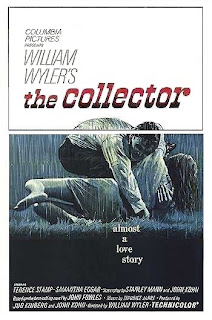 What is for sure is that as characters they exhibit directly opposing ideologies, of which we are constantly reminded. The Collector menacingly draws attention to their differing demeanors and viewpoints, the uptight stingy loner heaping all of the tension into the court of Miranda, who must defend everything that she is about. The Collector's chief mistake is making us too aware of what each of the characters is about, or at least trying to demonstrate this through silly, lazy means. Miranda's favourite book, The Catcher in the Rye, is dissected by Freddie in truly philestine fashion, and their essential differences are brought to the forefront in disappointingly plain terms: this man is all about himself, this woman is eager to explore. It's not to say that The Collector doesn't benefit from politics but the extent to which the two are at war with each other feels primarily mechanical and extracts from some of the unsettling confrontation. Terrence Stamp's dark, studious eyes contribute much more to his character than the narrative devices that accompany them. Particularly blatant is his coveted collection of dead butterflies (hence the film's title) which horrifies Miranda to the extent to which she later interrogates him about whether he intends to "collect" her. The reaction is rather terrifying, and does elevate the tension somewhat, but forms part of my main qualm with The Collector's tendency to demonstrate the sinister through rationale and mediation.
And yet, Wyler eeks so much out of a dull, stagnant setting, emphasising the power relations with menacing angles, boxing Eggar into dark corners and charting her fall from grace with monstrous precision. One gets the impression that Wyler extracts a lot from Eggar herself, and is at his most Hitchcockian in that Freddie in part feels like an authorial vessel, or at least a part-'victim'/faux-'villain' in the piece. Eggar, who conveys the defiance and panic of a fleety woman to whom 'repression' would undoubtedly exist in much more complex ways in the outside world, feels trained in the more explosive scenes, but in confronting Miranda's exasperation at the starvation of culture and concentrated banality of her new setting, she is at worst empathetic and at best a paladin.
I once met a psychologist who'd interviewed Fred West. Wyler's attempts to delve into the motivation behind abduction and obsession is rather like an evaluation of someone similarly beyond rationale. The Collector is a hell of a brave film for confronting the relatively unrelatable with what is, essentially, a battle of logic. It's a technique that's bound to deter people from fully committing to this film's ideas about obsession and practicality (I doubt Wyler would want that anyway) but deserves attention for portraying both Freddie and Miranda in a way that transcends traditional ideas about criminals and victims, and still managing to make its final point so utterly lucid.


