Showing posts with label Actress Profiles. Show all posts

Wednesday, January 18, 2012

Bitesize Best Actress Oscar Profiles: Jill Clayburgh

Jill Clayburgh in “An Unmarried Woman”
Lost the 1978 Best Actress Oscar to Jane Fonda in “Coming Home”

Grade: ***


If the sixties were all about the burning of bras and the breaking of boundaries, the seventies were more about re-evaluating relationships, gender roles, and the institution of marriage. Paul Mazursky, the helmer of wannabe-swinger comedy “Bob & Carol & Ted & Alice,” clearly had a lot to say about monogamy, returning nine years after that Oscar-nominated ensemble piece to write and direct “An Unmarried Woman,” about a housewife dealing with her husband’s decision to leave with another woman. Contrary to this period’s popular representation of women in relationships as mopey and often hysterical, Mazursky’s principal character Erica is a looser and more independent specimen when given the heave-ho. More associated with TV than film, Mazursky hired Jill Clayburgh as his plucky leading lady, a move which proved to pay dividends for both of them.
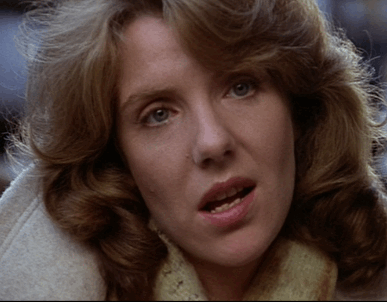
Jill Clayburgh's reaction to her husband's confession.
It’s little surprise that Clayburgh’s performance gathered so much love the year after Diane Keaton’s win for “Annie Hall”: there are many similarities to the free-spirited approach of the two characters once Erica breaks away from her jilted lover depression. With Annie it’s an ideology; with Erica it’s a defence mechanism, but both exhibit that façade of fleetiness which attracted so many cineastes of the moment. Although the humour can get very dry, Mazurky’s script has an uncanny knack of making Clayburgh’s many exchanges with questionable, erudite men feel adult and involving, and even when the actress is required to resort to insolent standoffishness she brings a wry, half-resigned tone which can gel with her director’s comic intentions.

“An Unmarried Woman” always regards Erica’s arc as its driving force, and in portraying such a scrutinised personality Clayburgh feels the burden of carrying this journeywoman heft through to a climax. Nor does she deal very well with the crucial reaction scene, responding to her husband’s confession of love for another woman with simmering hurt but no concrete, impacting sense of introspective turmoil, and the payoff line that Mazursky gives her (however misjudged) goes down like a lead balloon. At key moments Clayburgh treats the character analysis with lighter fervour than needed to plumb the depths of bitterness in Erica, more gamely and sprightly than mournful or contemptuous. One wishes that Clayburgh would distillate more of that steely verve into tangible heartache, rather than throwaway flickers of combat.

There are glimpses of the spirit of Carrie Snodgress’ nominated performance (in “Diary of a Mad Housewife”) referenced here, albeit with scepticism more vocalised than internalised, and with a considerably better sparring partner in Alan Bates to work with than Snodgress had with Richard Benjamin. If Erica feels predisposed to sympathy, neither Mazursky nor Clayburgh use this as a disclaimer for her actions, and despite this she often colours Erica’s progressive approach to relationships with hues of vital self-motivation. Crucially, for a film entwined in critiquing its era’s societal norms, Clayburgh’s showing hasn’t aged so badly, and she relays the assertion of “An Unmarried Woman” that to be “unmarried” is not to be “unhappy,” with admirable care.

Thursday, January 05, 2012

Bitesize Best Actress Oscar Profiles: Marsha Mason

Marsha Mason in “Chapter Two”
Lost the 1979 Best Actress Oscar to Sally Field in “Norma Rae”

Grade: **

When considering on/off-screen creative cinematic pairings, one’s instinct doesn’t necessarily gravitate towards Neil Simon and Marsha Mason. Tim Burton and Helena Bonham Carter are the most obvious dissenters of the unwritten “don’t mix business with pleasure” rule in this era, while Woody Allen’s doomed relationship with Mia Farrow led to an intense period of collaboration in the late 1980s. Neither of those partnerships directly resulted in an Oscar nomination for the performer, which makes Simon and Mason’s success with the Academy all the more remarkable. He penned three of her four nominated roles (in “The Goodbye Girl,” “Chapter Two,” and “Only When I Laugh”) in the space of five years, before their divorce in 1983.

Regarded as an actress who had a short shelf-life with audiences and Oscar alike, Mason was at the height of her popularity in 1979 when “Chapter Two” rolled around. Particularly dated, this romance has the early charm of a Simon script, as the courtship of Mason’s divorcee Jennie and James Caan’s widower George unfolds over the space of five snappy telephone calls. In these scenes Mason approaches flirtation with lively hints of wanting promise, but possesses that dose of cynicism associated with a weary singleton, and treats the character as she should do: a woman not inherently expecting anything, but who becomes dependent upon a man for the second time in her life. Mason shies away from telegraphing resistance as hostile or bitter, her wit less acerbic than stately, pronounced, and warmfully combative.

Both actors’ game punch and inherent likeability distract from the essential contrivance of their early exchanges, but the dialogue-heavy staginess eventually prevents them from delving beneath the surface-hangups of their characters. The injection of mawkish angst as a dramatic plot device only serves to emphasise the uneveness of the writing, more representative in George but nevertheless alienating us from both people who we thought we knew. The flaws in their relationship emerge abruptly, feel shallow, and are drawn out for far too long, that it’s no wonder Mason’s performance feels ultimately tiresome. Her tethered reactions to Caan’s muted self-pity, including one particularly epic monologue where she attempts to convince him why they should stay together, are fundamentally well-executed, but she can’t escape the compartmentalisation of her character into a reluctant confrontationalist which considerably hampers her ability to succeed in this production.

Mason is an actress with embedded self-supremacy, but it's far less suited to this role than it is in "The Goodbye Girl" and, particularly, "Only When I Laugh." She needs much more to chew on than is afforded her here, and in a looser narrative, where the occasional dismantling of her somewhat uptight persona translates as more natural than forced. Simon was a screenwriter with wild extremes of success, and as such this falls near the bottom of his hierarchy, and sadly Mason is unable to forge a path from this disadvantaged position much further than second base.

Thursday, November 24, 2011

Bitesize Best Actress Oscar Profiles: Anna Magnani

Anna Magnani in “Wild Is the Wind”
Lost the 1957 Best Actress Oscar to Joanne Woodward in “The Three Faces of Eve”

Grade: ***

Despite the pedestrian warbling of Johnny Mathis in the titular signature tune, “Wild Is the Wind” has clearly been made with the intention of ruffling feathers. The decision to cast impassioned actors Anthony Quinn and Anna Magnani (Mexican and Italian-born respectively) can only help but add intensity to a story of unhealthy attraction and morbid obsession. It’s especially interesting to see the rural side of America explored in a narrative which, in its subversion of burgeoning coupledom, traditionally lends itself more to white middle-class suburban woe, with newly-united pairing Gino and Gioia undergoing domestic turmoil. George Cukor, in a rare outing from the studio, mirrors an earthy setting with the tempestuous nature of the film’s romance, and one suspects that he didn’t have to work too hard to get these particular actors to comply with the theatrical entanglement in the script.

We’re immediately aligned with Magnani’s Gioia, who enters the film as a stranger to the rural American paradigm, and must learn to co-exist with Gino and adapt to his way of life. Early scenes in which Magnani is afforded the freedom of her Italian accent underpin the emotional alabaster of this woman, her tentative interaction with the farm folk invoking the magnitude of the cultural leap she’s taking. While the film dismantles this language barrier in order to usher the plot towards more scandalous intentions, and the ever-clearer themes of lust, identity, and belonging, Magnani is able to shape the experiental pitfalls of the woman and strongarm some identifiable, go-getting charm into her homemaking character.

Yet, particularly when the script is intent on generating issues for the couple, the hypersensitivity of Gioia as a fiery, stubborn woman isn’t always condusive to the development of the character, and in the repetitive instances of kitchen-based barneys Magnani doesn’t deviate much from bouts of severe frustration. This actress’ trademark physical imposition can restrict access to Gioia’s internal conflicts, too definite when confronting her husband over his many failures, with less of a tremulous sense of edge or self-doubt than somebody relatively new on the scene. This is a woman apparently governed by her impulses, but whom demonstrates emotional maturity only when the story suits, and with scene partners Quinn and Franciosa straddling wildly uneven extremes of angst, Magnani must shoulder most of that burden herself.

Magnani reacts to the kindling of her tryst with farmhand Bene with too much visible horror – an approach which makes the character appear too fickle, and somewhat neutralises the tragedy of her missteps towards the end of the film. She does, however, bring a naturalistic candour to this desolate landscape, and feels at home within the Tenessee Williams-esque elements of the narrative more than anyone else involved. The misguided theatrics of her performance dilute the nuance, but it’s an acceptable climax to this woman’s brace of Academy notices.

Thursday, November 17, 2011

Bitesize Best Actress Oscar Profiles: Fay Bainter

Fay Bainter in “White Banners”
Lost the 1938 Best Actress Oscar to Bette Davis in “Jezebel”

Grade: ***


Perhaps the greatest comment on behalf of Edmund Goulding's understated “White Banners” is that it makes a great advertisement for small-town America: a place where issues can be presented and overcome with grace and solidarity. It must be conceded that, after the initial cosiness of the home is established, there’s a heavy dose of earnestness to this accessible melodrama. What makes the film in many ways superior to similarly moral-driven pictures is in the performances – of and either side of Fay Bainter – who help to shape it into a worthwhile model of family life.

Of the ensemble Bainter’s Hannah remains most noticeably intriguing, predominantly because her character is less receptive to, or dependent upon, the influence of others, and her role as the film's insistent maid intentionally places her as the figurehead of the household. There are elements of self-righteousness to Hannah, which Bainter uses to allude to back-story – both within her half-hidden arc and outside of it. She finds ways to show how this woman has grown from her experiences, developed into a makeshift matriarch, turned dedication and presence into a valuable commodity to suit her needs. Long before the sympathies of the character are revealed, Bainter manipulates without offending – partly because she encounters little to no resistance, but also because she’s very difficult to distrust.

But for all of these minor successes this method also works against her, and the nature of the film’s narrative in the first hour essentially limits the amount of impact that she can achieve. The dedication to a storyline involving Claude Rains’ inventor character consigns the performance to flashes of matronly self-lionisation which ultimately inhibit her greatly, and there isn’t enough teeth-sinking opportunity in the prolonged middle portion. “White Banners” takes until the hour mark to endeavour to really upset the apple cart, this coming in the form of an incrementally hinted-at revelation from Hannah’s past, which colours our view of her considerably, and allows this actress to finally furrow grief into a guarded pillar of efficiency.

Bainter admittedly furnishes guilt and regret with a degree of plaintive mechanism in the final segment, but she does extricate emotion through revealing the character’s outlook to be more malleable and ambiguous than previously suggested. Her performance crystallises when the moment she has anticipated for most of the film eventually arises, and her concession of weakness when others force her to confront these issues from a different plain of thought brings added depth to Hannah. She’s given inklings of this before, but there’s mild surprise to the way in which she deals with the fraught collision of events that threatens to destruct. It can’t quite boost the resounding impact of her performance from congenial warmth to serviceable excellence, but it’s nontheless befitting of this emotionally intelligent, unendingly modest feature.

Friday, July 22, 2011

Bitesize Best Actress Oscar Profiles: Jeanne Crain

Jeanne Crain in “Pinky”
Lost the 1949 Best Actress Oscar to Olivia De Havilland in “The Heiress”

Grade: *


Jeanne Crain’s ivory complexion lends itself to “Pinky” about as well as Neville Chamberlain’s trusting nature lended itself to foreign policy – which is to say that even though bombs don’t fall and millions don’t die, “Pinky” and Crain are – on some level – a sorry tragedy of their own. Even if you can sidestep the cosmetic issues of a pale-faced ‘classic’ actress adopting the role of a Negro woman grappling with the implications of her race, Crain’s approach to Pinky doesn’t afford her much shade between resentment and allegiance.

I’m often excusing performers for the ineptness of their film’s production values – be that direction, script, or otherwise – but the blame here can be placed on Crain as much as it can on anyone else involved. “Pinky” isn’t a good film (it’s probably Kazan’s worst), but she badly gauges the arc of the character and struggles with the film’s insistence on offering degrees and variations on prejudice and discrimination. It’s depending on her to carve something linear and concrete out of the roundabout politics but instead she finds the bitter, wronged defaults in Pinky and rolls with them for most of the way. She’s rigid and standoffish in the way that she sleepwalks through the film, acting within the confines of her own ability and neatly – but blandly - delivering the piteous quips she’s given.

So one-track is Crain’s approach that she fails to strike a bond with any of her fellow actors, and is fatefully unable to generate empathy for the troubled heroine. Pinky’s blooming relationship with neighbour Miss Em, for instance, is supposed to represent a transitory period of enlightenment towards her view on racial relations, but all the work in these scenes is done by the ailing Ethel Barrymore. Crain is a stingy performer here, to the extent where you wonder what Miss Em has seen in Pinky beyond diligence and efficiency to warrant penning a last minute will-rewrite in her honour.  When engaging in conversation with her heritage-loving Grandmother (played by Ethel Waters) and understanding love interest William Lundigan, the same colourless surface of acrimony comes out to play, as Crain consigns Pinky to a fixed position of intellectual superiority and mild disappointment.

It isn’t necessarily a question of being amiable; Crain is attempting to embody a woman difficult to like, who is hostile towards threats to her standing and ungrateful in many aspects of her life. Although she is keen to access the sense of injustice in this girl, the snappish, quicksmart ‘qualities’ in her manner are not suited to distilling the gritty social commentary, and even less inclined to richen the would-be-tense dichotomy of this community. Crain’s reward of an Oscar nomination probably derived from her dual work in this and Joseph L. Mankiewicz’s “A Letter to Three Wives” the same year, but collectively it really doesn’t amount to much. If 1949 had looked like a pale Best Actress year Crain hasn’t altered that impression, tossing her own strain of tedious inertia onto an already dispiriting roster.


What say you? Was I too harsh on Jeanne Crain's abilities here? Is she merely scuppered by the film's other elements; or is she so at fault that one star reads as generous?  Speak up!

Saturday, July 16, 2011

Bitesize Best Actress Oscar Profiles: Irene Dunne

Irene Dunne in "I Remember Mama"
Lost the 1948 Best Actress Oscar to Jane Wyman in "Johnny Belinda"

Grade: *

After four nominations in eight years Irene Dunne had to wait another eight to grab her fifth and final one, as the Norwegian matriarch in George Stevens' "I Remember Mama." The film was such a smash with the Academy that it managed four acting notices: Oscar Homolka, Ellen Corby, and Barbara Bel Geddes completing the quartet. Even if none of these performances are individually exceptional, the ensemble forms a strong family dynamic – surely the basic requirement for a film which so staunchly promotes cohesion within the home.

Some might call this Dunne's Hollywood swansong (she made three modest features films after this one) and she certainly radiates that veteran Actress vibe in a way that puts her stuffy showing the previous year in Michael Curtiz’s "Life with Father" to relative shame. The screenplay idolises Dunne's Mama as the Mother of all mothers; a woman struggling to feed her kids properly but whom somehow finds a way to make them all happy, and whom sacrifices her own miniscule pleasures for – among other causes – the sake of daughter Katrin's stage play, and son Nels' desire to go to high school.

Dunne’s perennially-likeable persona is at least present here, in the confines of brave-faced solemnity, and particularly flickering in many of her scenes with the adoring Katrin. It’s the centrally resonant relationship in the film, as Dunne telegraphs Mama’s identification with her plucky, spirited daughter with knowing reverence. She recognises what it means to dream about a better life, and – to some degree – how it feels to achieve it, and allays the film’s emulsion of heritage with able aim. The difficulty for Dunne is that Mama is too manifestly disciplined and wise. She feels bound by the expectations of reliability the film generates for her character, and assumes a role we’ve essentially seen countless times before, in an imitable stab at matronly, Beulah Bondi-style emotional distancing.

Dunne digs out dulcet, groaning tones for her Norwegian accent, skipping prepositions to show that Mama hasn’t quite grasped the English language, and phrasing consternation with low-pitched mechanics.  Call it painting by numbers if you will, but for lengthy periods she doesn’t have much of a choice but to dot the 'I's and cross the 'T's of the script, and its crystallised view of foreign settlers as humble family folk with little else to worry about besides holding onto what they have. There just isn’t much to “I Remember Mama” or Mama herself to coax Dunne out of facile, forlorn gestures towards her warring relatives and angst-ridden children, effective in a scene where her daughter retrieves her pawned brooch, but reluctant to give the character any edge.

Dunne isn’t the only person guilty of picking such uniform family drama scripts; “I Remember Mama” and “Life with Father” represent some of the worst work of their directors George Stevens and Michael Curtiz too. While Stevens attempts to rescue his through cavernous camerawork, Dunne does what comes natural and foists the saintly nature of Mama’s firm maternal instinct with delicate charm. For Mama to be a success, she needed someone like Anna Magnani to grab her by the scruff of the neck and add some slovenly realism to her statuesque frame. Instead we get an Actress skating on broodier ice than she’s used to, and opting for single axels rather than triples.

Monday, July 11, 2011

Bitesize Best Actress Oscar Profiles: Anjelica Huston

Anjelica Huston in “The Grifters”
Lost the 1990 Best Actress Oscar to Kathy Bates in “Misery”

Grade: ***


Renowned for her formidable, disconcerting presence, Anjelica Huston was on stellar form in 1990, first scaring audiences to death in Nicolas Roeg’s adaptation of the famous Roald Dahl book, “The Witches,” and months later returning to haunt John Cusack’s troubled con-artist in stylish crime thriller “The Grifters.” As both a Witch and a Grifter, Huston asserts an air of immovability, and exercises a bitter self-righteousness towards those that pertain to know better than she does. While the maniacal nature of her cosmetic, made-for-children performance in the former offers no doubt to her character’s motivations, in Stephen Frears’ film one is likely to ponder more dubiously over whether her bite lives up to her bark.

Cusack’s troubled Roy never once refers to Huston’s Lily as a maternal figure, having clearly relied on her very little as a child. Estranged mother and son, Roy and Lily haven’t seen each other in the eight years before “The Grifters” commences, and boy it shows. Huston’s attitude towards him in their reunion scene is one of someone revisiting former shame – and her behaviour has such a removed, clinical edge to it, without making Lily seem operatically cool (like Swanson or Crawford might have), or stretching to the psychosexually trashy levels of dementia Diane Ladd opted for in “Wild At Heart.” You can see her going through the motions, remembering how it feels to care, and even amidst the stony Medusa glare Lily uses as a physical defence mechanism, there’s a solemnity and sheer terror at having to confront this area of her life again.

Huston’s underplaying of the role aids in clouding an already uncertain relationship, but it isn’t always to the benefit of the character or the film. Frears doesn’t seem to get what Lily is about – or at the very least isn’t as concerned about her as he is about Roy or girlfriend Myra (a Glorious Annette Bening) – and doesn’t give Huston much opportunity to demonstrate the more inherently volatile characteristics of Lily. “The Grifters” is often interesting, but pretty tonally half-baked, and Frears is far too shy in plugging the pulpier devices of the narrative, opting instead for sinister stylisation and repetitive visual tropes. You can sense Huston struggling to put her stamp onto scenes (especially those which feature Bening) as it’s unclear whether Lily is supposed to be predominantly jealous of Myra or wise to her youthful, rash ambition.  The politics behind the relationship triangle never seems to reach the forefront of the film’s motivations, and Huston’s time-biding style of intuitive acting rarely sees a point of refraction to exploit in the underwhelming efforts of John Cusack.

Resultantly, however, Huston dredges sufficient amounts from Lily’s character – more through layering this woman’s history onto celluloid than dealing with the here and now of her predicament. A scene in which she is wholly subservient to her boss offers a wealth of history in that regard, and in the tensely-played finale she finds a more emotive outlet in Roy than she’s ever offered. Nevertheless, Huston can’t shake off the frustrating aloofness of “The Grifters” as a tentative adaptation, more thoughtful and noteworthy than the nondescript ethics of the film itself, but still a slighter entity than the powerhouse actress we’ve grown accustomed to. 

Thursday, June 30, 2011

Bitesize Best Actress Oscar Profiles: Meryl Streep

Meryl Streep in “Out of Africa”
Lost the 1985 Best Actress Oscar to Geraldine Page in “The Trip to Bountiful”

Grade: ***


Sydney Pollack’s “Out of Africa” is all but cursed from the moment Meryl Streep’s voice-over booms out the words, “I had a farm in Africa…” – which, incidentally, happens in the first five minutes. Wholly distracting to the director’s establishing shots of grassy, romantic plains and Mogambo-style odes to wildlife, Streep’s intonation is supposedly inflective of an elder, Danish woman seeping out her last remaining nostalgic syllables. The grating reality is that there’s an element of Greer Garson’s elder Mrs. Parkington going on here; even if we never see Streep’s Karen Blixen age as drastically, or frown as raptly as Greer’s curious creation.

As is the case with so much of “Out of Africa” Blixen’s retrospective storytelling smacks of filmmaking built on themes inspired by literary classics, but with none of the dramatic clout or sound character development required to vitalise a period adventure. Instead this is more like a later David Lean epic, rife with weak symbolism and muted exchanges, and a safari setting so estranged from the characters that one struggles to surmise why on earth Streep’s Karen wants to be there in the first place. She may rock Milena Canonero’s costumes like a pro but otherwise Streep can’t engage with her aesthetic surroundings like a woman excited to be involved in new climates, relationships, communities; and in pockets of “Out of Africa” she navigates the pretty vacancy of Pollack’s inane setting like a lost, wounded animal.

She very nearly is wounded in a scene where a lion considers her for its dinner, only to act just as Redford’s Denys suspects and veer off into the wilderness of its own accord. It’s one of those flimsy attempts to develop the trust in Karen and Denys’ barely-there relationship, which is apparently blossoming even as Streep and Redford flounder under the self-consciousness of their scenes together. The pair are strangely neutered as personalities under the pressure of having to carry the Romance in the Romantic Epic, and their tryst only really garners interest when the film explores the pair’s opposing views on commitment. Streep’s at her finest when she telegraphs Karen’s struggle between free-spirited compassion and her staunch ideals of exclusive coupledom, clearly exasperated by Denys’ bachelor-style distancing, but wise not to foist her views so recklessly as to drive him away. Eventually, Karen reverts to that modus operandi as a confluence of lovestruck emotion, but Streep underplays this selfish streak to her character for longer than many an Actress would, and rallies us to a romantic cause without really appearing to try.

Despite the already-established promotion of romance as the film’s chief entity, “Out of Africa” and Streep achieve much deeper degrees of emotion through charting the disintegration of Blixen’s relationship with her Baron husband, played by a remarkable Klaus Maria Brandauer. Despite being socially-suited they never click as a couple (although she tries far harder than he does) and even after he behaves badly towards her Streep relays Karen’s strange affection for him - during and after their divorce – as a resigned, natural acceptance that their marriage was not meant to last. You can see that she admires his honesty, relates to the pressures of his standing and, crucially, empathises with his desire to be with someone who makes him happy. Streep’s attitude towards him oscillates between how one might treat an enemy, a maverick, a friend; and for however ephemeral a time, gives us a reason to cling onto Karen Blixen – a woman perhaps underserved by this lengthy, conventional tale.

There are chapters of “Out of Africa” that really alienate Streep; that paint Karen as a dilettante, ponderous and impenetrable like her Sarah was in “The French Lieutenant’s Woman.” Much of that is hardly fair on an Actress quite marooned in a film geared towards looking like a finished article than being that finished article: this is a performance certainly not belonging to the healthy echelons of Streep’s vast collection of Academy notices, but she’s still a prize asset to a production devoted to forests and sands.

Wednesday, May 18, 2011

Bitesize Best Actress Oscar Profiles: Debbie Reynolds

Debbie Reynolds in "The Unsinkable Molly Brown"
Lost the Best Actress Oscar in 1964 to Julie Andrews in "Mary Poppins"

Grade: *

Somewhere in the annals of Oscar history lies Debbie Reynolds, neither completely shunned by AMPAS nor fully embraced; ignored for arguably her best performance (in "Singin' in the Rain") but rewarded for playing Denver's illustrious millionairess, the "Unsinkable" Molly Brown. Having earned that moniker for surviving the Titanic's fateful journey across the Atlantic, Brown is a role that most (including I) likely associate with Kathy Bates, who took it on for James Cameron's record-breaking 1997 blockbuster. In actuality, it stretches way back to 1964, a good thirty-two years after Molly herself passed away.

At the risk of disappointing those hoping for a slice of genuine action from Charles Walters' film, the sinking of the Titanic takes up less than five minutes of this already-bloated two hour biopic. The rest is dedicated to charting Molly's journey from Brash Missouri Upstart to Cultured Society Dame, beginning in the vein of Calamity Jane, with its brutishly technicolour approach to musical showpieces and reinforcement of rural community. Reynolds handles the goofiness of these early scenes by emphasising the raw, barely-civilised farm girl in Molly with all the subtlety of a newly-hatched pterodactyl, and doesn't much deviate from this technique for the first hour of "Unsinkable." To criticise Reynolds is to criticise Walters; slapping this much tedious, blue-collar theatrics onto the film feels like a vastly unnecessary way to colloquialise Molly, and one that Reynolds understandably struggles to involve herself with. Of the two opportunities she's afforded in this period, she doesn't manage to deepen Molly during either, first extending her wide-eyed shtick to accommodate faint joy in acquiring a dream house with fiancée Johnny. The second - and by far the most embarrassing scene in the film - sees her search tirelessly for a place to hide the couple's $300,000 worth of bonds, only to settle on laying them to rest at the bottom of the gas stove. Inevitably this does not end well, and the farcical nature of the situation leads Reynolds to regress into her munchkin version of vaudeville as she and her husband play a domestic version of Tag.

When Molly and Johnny move to Denver's lavish neighbourhood the central issue of its heroine is eventually revealed, as she willingly attempts to educate herself in social etiquette to fit in with the snobby society folks actively snubbing the Browns. At last a chance for Reynolds to document something less definite about Molly! As the couple venture through Europe in the hope of gaining valuable cultural knowledge, Reynolds gains figurative weight, excising the impulsiveness of Molly and revealing her heightened sense of self-awareness. A scene in which European friends celebrate her birthday is Reynolds' highlight, as she swigs a glass of champagne with visible glee, and sways it like a sceptre as she addresses them at the head of the table, inherently more careful about the grace of her actions than she ever has been before. She still has that inkling of the tearaway about her, but is using it to her advantage rather than exposing it as a stamp of who she is. Reynolds fares better in this period because she's able to hold the character in a more suspended state, but doesn't really carry this level of incisiveness over to the film's final act.

Reynolds' nomination feels particularly strange considering the striking parallels between the arc of Molly Brown and My Fair Lady's Eliza Dolittle, and the mild success of that film in coaxing a performance out of Audrey Hepburn that can detail the transcendence of social boundaries with patience and some finesse. Perhaps the crux of it was that Reynolds did her own singing? Either way, the diaphanous politics of Molly's quest for graces doesn't quite coax Reynolds out of becoming a passive figure for this greedily sprawling musical biography. The Titanic may not have been able to sink her, but I have no reservations about dropping this particular anchor at the one-star mark.

Thursday, April 02, 2009

Actress Profiles: Mia Farrow in Rosemary's Baby (1968)

Despite receiving five Golden Globe Nominations (MP) and three BAFTA notices, Mia Farrow has never been nominated at the Oscars. Puzzlingly, none of those nominated performances include her brilliant turn in Death on the Nile, where she plays the drunken, jealous ex of a British tourist. Her presence in Rosemary's Baby, however, is probably the closest she came to a date with the Golden Guy crew, given that the film managed a Screenplay nomination, and a Supporting win for Ruth Gordon, as well as the fact she's in nearly every scene.

Farrow's role is, quite obviously, not a stock one, as the initially enthusiastic and eager-to-settle Rosemary eventually becomes a wailing beacon of paranoia. As with most horror films, the establishment of equilibrium wants us to see Rosemary as a familiar, fawn-like heroine, walking blindly into a hunter's trap. It works: Farrow, as ever a warm and easy presence on-screen, gives us the foothold of honesty that we need, but she also lets us see the pretense in her attempts at home-making, the inherent motivation of the woman to dismiss or distract from the insecurities of her relationship with Guy (Cassavetes). As a character, Farrow makes Rosemary, timid in demeanor but clear in focus, feel above and beyond her malleable surroundings; immersed, impelled, thoroughly self-alienating, and an awfully easy target.


In many ways, Rosemary's fate is an inevitable one. Lord knows, there's defiance and fight in this woman, but the apparent victory of her conception blinds her from realising (at least for a while) that she does not have everything her own way. She even endures pain for months on end, believing that it's down to purely natural behaviour. But as the penny starts to drop, and Rosemary is forced to exercise her suppressed challenge and independence, is where Farrow unquestionably excels.

The success of Polanski's film most lies in its nonchalance; the denial, the unspoken. Its mellow tone simmers and starts, but rarely goes into overload, and keeps the overt drama to a bare minimum. The idea of satanism and witchcraft is something Rosemary would surely have balked at at one time or another, but believably forms the underlying basis of her newfound drive and purpose, as much of a way to free herself of the restrictions of pregnancy than to find hidden truths. Farrow masters the confluence of comedy, perplexion, investigation, and fear, whacking up the intensity but sticking with the character's narrow perceptions, and embedding her descent into fully-fledged realisation with the scorn of an exploited woman. One gets the impression that she feels as bloodthirsty as she does wronged, and the final scene handily leaves you exactly that to ponder.

Saturday, March 07, 2009

Actress Profiles: Ruth Chatterton in Dodsworth (1936)


Dodsworth opens to ambitious, rectilinear art direction and luscious cinematography. It's a prelude to the European glamour that will inevitably follow, Samuel Dodsworth's sale of his own motor company in favour of retirement and a journey to Europe with his beloved missus the end of the line for the working man. His friend picks up on this in the film's opening minutes, more than hinting that Mrs. Dodsworth, Ruth Chatterton's Fran, is leading this dynamic businessman into a life of smoke and mirrors. It's an accusation that we deem as rather harsh in the beginning. After all, this woman has (presumably) stood by him since marriage, looked after his home, raised his kids, and so isn't she entitled to some me-time with her husband? As it turns out Dodsworth's friend isn't too far away, and one of the many effective realities of Ruth Chatterton's enthralling performance is that her betrayal is such an instinctively long-lasting one, and yet by the time it comes seems completely unpreventable. This film works wonders in allowing us to see husband and wife both for what they are, despite aligning us very much with the male party.

Chatterton, like all thirties leading ladies, has immeasurable beauty, and her character is refreshing in the sense that she knows and is able to exploit this beauty instead of it being relayed to her by a handsome knight in shining armour. Not that she doesn't need affection, in fact she craves it, but more through the fear of an unknown future than body hangups. She's rather like Scarlett O'Hara, navigating the male population of Seven Oaks for ninety minutes, assuredly desired but never wanting to think about tomorrow. But while O'Hara was young and understandably carefree there is an err of desperation to Fran's self-preservation and fascination with her own lofty image. An antidote to Huston's direct, honest and upfront hero the film is keen to place her at its main focus point, and it's a brave move of Chatterton to make Fran so unsympathetic. Her dismissive gaze renders spouse Samuel (and us) as powerless voyeurs to her vanity, and as she revels in the newfound power and freedom afforded through ascension from housewife to playgirl, Chatterton and Dodsworth become especially valuable, offering up different perceptions about the meaning of marriage, and how those vows concerning love, honour, and forsaking all others can become diminished or moulded with time.

Fran is not a particularly likeable character but shares the fate of fallen women like Stanwyck, Signoret, Taylor et al. that fished a line out to AMPAS and duly received a chomping response, which in turn makes it all the more surprising that she was passed over for other Actresses, most unfathomably Luise Rainer's bizarre turn as a jilted performer whose repertoire features a song about bumblebees nonetheless. It's also strange that Dodsworth was able to grab other nominations for picture, director William Wyler, actor Walter Huston, and supporting actress (Maria Ouspenskaya for a three-minute scene with Chatterton), but not for its leading lady. Alas, you can't win them all. Ruth Chatterton is more than worthy of her fancy flick, emanating the insidious desires of Fran without drawing attention to them, and believably, palpably wrestling with time.

Monday, October 27, 2008

Actress Profiles: Talullah Bankhead in A Royal Scandal (1945)


As the figurehead of any imperialist nation the monarch is supposed to be the person you live for, fight for, and die for. The role of the monarch, an increasingly less productive and passive one if you consider history, has seen its fair share of victims. Talullah Bankhead, as Russian Czarina Catherine the Great, is indeed one of those people worth living, fighting, and dying for, but is certainly no less ambivalent than your average Kaiser, Emperor, Queen, or otherwise and a great deal more honest in articulating just how little she does know (or really care) about her empire and the people in it. A Royal Scandal depicts an often trashy and frivolous comedy within the confines of an adorned part of Russian heritage, and refuses to show what life is like outside of this campy madcap palace. What it does do, however, is introduce an outsider, soldier Alexei, who proceeds to really shake things up, both through his strong political beliefs and his devilishly good looks, which make more than an impact upon the restless monarch.

It's twenty minutes before Bankhead makes an appearance in A Royal Scandal, the first portion of the film dedicated to Charles Coburn's absorbing, charismatic Chancellor, William Eythe's plucky and eager Liutenant, and Vincent Price's hilarious scene-stealing performance as a French ambassador. It's a smart move, because without these early exchanges there simply wouldn't be the sense of politics or cohesive network within the palace that is vital to the film's final act, and it would diminish the anticipation and subsequent satisfaction of being introduced to a woman that makes such a lasting impression with every flail and quip that it's almost a punishment when she's not on-screen.


If you've seen Lifeboat it's easy to guage that Talullah has a real gift for rattling off one-liners and being deliciously dismissive of people in bitchy diva-esque fashion. As a morally-questionable Russian leader she gets the opportunity to be this diva, and as in Hitchcock's wartime tale, not an infallible one. It's interesting though that A Royal Scandal flourishes so well as a piece of political satire despite exhibiting many of the hallmarks of the screwball style. Love triangles, sexual innuendo and a lot of farce litter this film, and if made ten years earlier the master of the screwball idiot, Ralph Bellamy, would surely have made a beeline for the role of Alexei. For Bankhead, however, it's something to think about.

The very nature of A Royal Scandal's approach to Catherine the Great -- portraying her as a rather willing damsel, swallowed by her own power and inability to utilise it effectively -- gives Bankhead a lot to work with, and she doesn't disappoint. The nature of her Catherine is strong, stubborn, charismatic, but rather insecure in herself (something contradictory of a true screwball heroine) and seemingly entrenched in a behind-closed-doors existence. She wants so desperately to perch herself on an incomparable pedastal but doesn't put this into practice, getting involved in silly trivialities in her court, unable to tear herself away from what she's supposed to be better than. It's rather sad in a way but Bankhead makes the Czarina such a flexible character; a very component of the rasping infrastructure that makes her position vulnerable in the first place, and someone whose bark and bite seem separated by a wave of intrigue. It works.

Rating: ****

Saturday, April 05, 2008

Actress Profiles: Geraldine Page in What Ever Happened To Aunt Alice? (1969)

Geraldine Page in What Ever Happened To Aunt Alice? (1969)


Following in the footsteps of camp horror classics of the time, What Ever Happened To Aunt Alice? has replaced Bette Davis' Baby Jane with an even more daunting prospect (believe me) in Claire Marrable, a character brought to life by the incredible, sinister performance of Geraldine Page. Similar to Aldrich's 1962 flick, Marrable is given cause to feel bitter in the films opening moments, when it is revealed that her husband's apparent wealthiness was a facade, and he has left her in a mountain of debt. Enough cause to get pissed? Certainly. But perhaps going on to coax money out of your housekeepers on the false promise of stock market dividends, and then proceeding to systematically kill them off one by one is taking it a step or ten too far.

Yet Page's Marrable seems to have an extra edge that Baby Jane did not. Driven by necessity her character alters without appearing to: uneasing, pressing, agressing, slowly revelling in power, her cackles a pierce that underline her ecstasy at being in control. Page is the ultimate villain. A woman designed to unsettle. And with the dismissive flick of a sherry glass she can turn the tables on you so quick, delivering gestures of a false hostess and scathing insults of a masked monster (and sometimes both in the same breath) like a ruthless predator who believes herself at the head of the food chain. I daren't deny her that.

Rating: *****

Actress Profiles: Katharine Hepburn in Holiday (1938)

Katharine Hepburn in Holiday (1938)


Katherine Hepburn is an eccentrically-endearing chatterbox. While that was admittedly annoying (intentionally, though, and gloriously over-the-top) in Howard Hawks' Bringing Up Baby, her role in George Cukor's Holiday is of a 'tamer' (at least physically) love interest for screen partner Cary Grant, and thus probably a more convincing one. After all, would a man really fall in love with a girl who ransacked his wedding, lumbered him with a leopard, and single-handedly dismantled his relationship? Grant's weak, easily-led scientist is a product of Hepburn's ability to put you under her spell and make you forget about the consequences, but the situation is different in Holiday.

Her penchant for thinking out loud (usually rashly) is put to good use in what is a film that successfully attempts to detail social transition through the dilemna of love versus principle, a consideration afforded less room to breathe in dominant Hollywood romance. Perhaps it's Hepburn's greatest feat though that she makes us feel like her mind is such an expansive and fascinatingly forward-thinking one that you can see her struggle (often with guilt) to see things for what they really are: an internally-ingrained dilution of thought, if you will.

Rating: *****