Thursday, December 01, 2011

The Not-So-Silent Backlash & NBR Predictions

As the saying goes: ‘silence is golden’, but if many people have their way, the silent film that has so far won over several festival audiences and at least one major critics group, will not be crowned the best of 2011. Monday afternoon saw the announcement of the New York Film Critics Circle winners, as well as this year’s Indie Spirit nominations, both of which gave Michel Haznavicius’ “The Artist” a boost with Picture, Director, Leading Actor, and Cinematography notices. The aftermath of NYFCC’s awardage of the film with its two biggest prizes proved unexpectedly negative, the decision labelled safe, and the film denounced as a novelty by high-profile figures. “The Artist” isn’t terribly original because it’s an homage which lends plot devices from classic cinema, but it’s far more comfortable with what it is and tight in story-structure than most of the other frontrunners. It may not necessarily be a five-star film but it certainly trumps the likes of “The Descendants,” “The Help,” and “Midnight in Paris.”

It remains to be seen whether the film can build upon its New York win to mount a strong showing with the critics, which previously appeared unlikely. With its nose firmly put out-of-joint the National Board of Review votes for their ten best films today, and although “The Artist” seems within the mould of their admittedly old-fashioned preferences, I’m going to hold off on suggesting it can set the ball rolling for a sweep. This year feels like more of a scattered, spoil-sharing prospect after last year’s uniform endorsement of “The Social Network” – especially with voting bodies seemingly at war with one another. All things considered, “Moneyball” remains the best-reviewed film with realistic awards potential, so it makes sense for it to win a prize from a significant voting body (whatever your view on the NBR, their opinion carries weight).

The top ten is a minefield to predict, but you can be assured that they like political dramas, so this could be a handy get for the dwindling “The Ides of March,” and they always include Clint Eastwood’s films so expect “J. Edgar” to pop up here despite the disastrous reviews. From there, it gets tricky. Who knows if they’ll even remember those earlier acclaimed films “Beginners,” “Jane Eyre, “ and “Win Win”? Are “Melancholia,” “Martha Marcy May Marlene” and “Take Shelter” a bit too far outside of the box for this group? Your guess is as good as mine.

Picture: “Moneyball”
Alt: “The Artist”

Top Ten:
“The Artist”
“Beginners”
“The Descendants”
“Hugo”
“The Ides of March”
“J. Edgar”
“Midnight in Paris”
“Rise of the Planet of the Apes”
“The Tree of Life”
“War Horse”

Director: Martin Scorsese, “Hugo”
Alt: Terrence Malick, “The Tree of Life”

Leading Actress: Michelle Williams, “My Week with Marilyn”
Alt: Elizabeth Olsen, “Martha Marcy May Marlene”

Leading Actor: Brad Pitt, “Moneyball”
Alt: George Clooney, “The Descendants”

Supporting Actress: Jessica Chastain, “The Help,” “Take Shelter,” “The Tree of Life”
Alt: Vanessa Redgrave, “Coriolanus”

Supporting Actor: Christopher Plummer, “Beginners”
Alt: Kenneth Branagh, “My Week with Marilyn”

Screenplay: “Moneyball”
Alt: “The Descendants”

Animated Feature: “Rango”
Alt: “Chico & Rita”

Foreign Film: “Certified Copy”
Alt: “A Separation”

Documentary: “Project Nim”
Alt: “The Interrupters”

Wednesday, November 30, 2011

Review: The Descendants

The Descendants
Directed by Alexander Payne
Starring: George Clooney, Shailene Woodley, Matthew Lillard, Judy Greer, Robert Forster
Grade: C+


As maudlin voiceovers go, Miranda July’s cat-on-a-deathbed soliloquy in “The Future” has competition for the prize of ‘most annoying of 2011’, as George Clooney’s opening gambit in the wearily-spirited “The Descendants” may narrowly beat it out. In a speech in which Hawaii is characterised as a pillar of heritage, Clooney’s Matt King divulges to the audience the exposition that director Alexander Payne (“Election,” “About Schmidt,” “Sideways”) neglects to integrate into the narrative insightfully – which is that Matt’s wife Elizabeth is in a coma as a result of a boating accident, and that he’s struggling to take care of his two daughters. A fine premise for a film, given Payne’s history of resisting the urge to plumb the tearjerking sensitivities in his scripts for emotional effect, but as “The Descendants” proves: there’s always one exception to the rule.

Burgeoning talent Shailene Woodley’s entrance into the story as inebriated, frolicking teen Alexandra gives her the tag of the problem child, but is dismantled fairly soon after the daughters are rounded up to hunt down their dying mother’s fellow adulterer. The film charts Matt’s attempts to deal with the revelations of his wife’s recent behaviour, and his confrontation with the reality that many of his questions about their life together may well be left unanswered. In the midst of crises Matt’s relationship with his two daughters slowly comes together, revealing them to be a genuine unit, even as the early scenes had threatened to expose this as a hiding to nowhere. The genealogical angle employed to give the title added meaning sees Matt and his shareholder relatives in negotiations to sell the expanse of land on the island belonging to their ancestors, providing him with a secondary avenue in which to determine what ‘family’ means.

“The Descendants” boasts an unlikely setup for a comedy, but its blackness comes off as largely honest. The use of the Hawaiian setting to illustrate the film’s theme of disconnection works effectively in mirroring the tenuous nature of the frayed relationships within the family, and, whether as a result of having to make do with being thrown together or through the guidance of a director looking to develop the premise through the skills of his actors, the ensemble of “The Descendants” find a way to somewhat authenticate this band of people. There’s a makeshift sense of construction to their interactions which works within the film’s dramatic arc, and Payne’s presentation of familial solidarity-in-progress at least finds a way to resonate uniquely and effectively. Much of this can be attributed to the supporting performances surrounding Clooney, whose instincts for dry comedy have always felt like a neutered form of his zany “O’ Brother Where Art Thou” shtick. He has soulful moments but mostly relies upon the presence of Krause, Miller, and particularly Woodley alongside him, whose layered performance looks set to grab awards attention.

The problems lie in the strange tone of the film, and the tendencies of the humour to cheaply play to the audience. With alarming regularity, Clooney and his troupe go island-hopping at the drop of a hat, aided by tag-a-long Californian oaf Sid in the designated role of an outspoken jackass. There’s more than an element of “Little Miss Sunshine” to this family-outing setup, diluted by the morbidity and emotion of the predicament, but nonetheless indicative of Chabrol-style whimsy, alienating us from the characters as much as it draws us to them. Payne isn’t shy when it comes to big confrontation scenes, but he often uses directness to further the story when it doesn’t seem best appropriate, and his and Clooney’s attempts to extricate empathy for Matt occasionally fall on deaf ears.

There's something of Alexander Payne lurking in "The Descendants," beneath its unmistakeable plotting, infantile humour, and precious advocacy of togetherness. It has the midlife crisis-element of “Sideways,” the adolescent angst present in “Election,” but, more than anything else, exhibits the caustic charm of "About Schmidt" – albeit with a touch more humanity and considerably less nudity. Like Almodovar with the maligned “Broken Embraces” Payne’s auteurial gaze rakes over old ground, but lightly riffs rather than wickedly satirising, and ultimately feels like a backwards tread. However well its assemblage of young actors can pull off ‘artfully precocious’ with rounded aplomb, “The Descendants” surely represents this filmmaker’s most flawed work to date.

Thursday, November 24, 2011

Bitesize Best Actress Oscar Profiles: Anna Magnani

Anna Magnani in “Wild Is the Wind”
Lost the 1957 Best Actress Oscar to Joanne Woodward in “The Three Faces of Eve”

Grade: ***

Despite the pedestrian warbling of Johnny Mathis in the titular signature tune, “Wild Is the Wind” has clearly been made with the intention of ruffling feathers. The decision to cast impassioned actors Anthony Quinn and Anna Magnani (Mexican and Italian-born respectively) can only help but add intensity to a story of unhealthy attraction and morbid obsession. It’s especially interesting to see the rural side of America explored in a narrative which, in its subversion of burgeoning coupledom, traditionally lends itself more to white middle-class suburban woe, with newly-united pairing Gino and Gioia undergoing domestic turmoil. George Cukor, in a rare outing from the studio, mirrors an earthy setting with the tempestuous nature of the film’s romance, and one suspects that he didn’t have to work too hard to get these particular actors to comply with the theatrical entanglement in the script.

We’re immediately aligned with Magnani’s Gioia, who enters the film as a stranger to the rural American paradigm, and must learn to co-exist with Gino and adapt to his way of life. Early scenes in which Magnani is afforded the freedom of her Italian accent underpin the emotional alabaster of this woman, her tentative interaction with the farm folk invoking the magnitude of the cultural leap she’s taking. While the film dismantles this language barrier in order to usher the plot towards more scandalous intentions, and the ever-clearer themes of lust, identity, and belonging, Magnani is able to shape the experiental pitfalls of the woman and strongarm some identifiable, go-getting charm into her homemaking character.

Yet, particularly when the script is intent on generating issues for the couple, the hypersensitivity of Gioia as a fiery, stubborn woman isn’t always condusive to the development of the character, and in the repetitive instances of kitchen-based barneys Magnani doesn’t deviate much from bouts of severe frustration. This actress’ trademark physical imposition can restrict access to Gioia’s internal conflicts, too definite when confronting her husband over his many failures, with less of a tremulous sense of edge or self-doubt than somebody relatively new on the scene. This is a woman apparently governed by her impulses, but whom demonstrates emotional maturity only when the story suits, and with scene partners Quinn and Franciosa straddling wildly uneven extremes of angst, Magnani must shoulder most of that burden herself.

Magnani reacts to the kindling of her tryst with farmhand Bene with too much visible horror – an approach which makes the character appear too fickle, and somewhat neutralises the tragedy of her missteps towards the end of the film. She does, however, bring a naturalistic candour to this desolate landscape, and feels at home within the Tenessee Williams-esque elements of the narrative more than anyone else involved. The misguided theatrics of her performance dilute the nuance, but it’s an acceptable climax to this woman’s brace of Academy notices.

Thursday, November 17, 2011

Bitesize Best Actress Oscar Profiles: Fay Bainter

Fay Bainter in “White Banners”
Lost the 1938 Best Actress Oscar to Bette Davis in “Jezebel”

Grade: ***


Perhaps the greatest comment on behalf of Edmund Goulding's understated “White Banners” is that it makes a great advertisement for small-town America: a place where issues can be presented and overcome with grace and solidarity. It must be conceded that, after the initial cosiness of the home is established, there’s a heavy dose of earnestness to this accessible melodrama. What makes the film in many ways superior to similarly moral-driven pictures is in the performances – of and either side of Fay Bainter – who help to shape it into a worthwhile model of family life.

Of the ensemble Bainter’s Hannah remains most noticeably intriguing, predominantly because her character is less receptive to, or dependent upon, the influence of others, and her role as the film's insistent maid intentionally places her as the figurehead of the household. There are elements of self-righteousness to Hannah, which Bainter uses to allude to back-story – both within her half-hidden arc and outside of it. She finds ways to show how this woman has grown from her experiences, developed into a makeshift matriarch, turned dedication and presence into a valuable commodity to suit her needs. Long before the sympathies of the character are revealed, Bainter manipulates without offending – partly because she encounters little to no resistance, but also because she’s very difficult to distrust.

But for all of these minor successes this method also works against her, and the nature of the film’s narrative in the first hour essentially limits the amount of impact that she can achieve. The dedication to a storyline involving Claude Rains’ inventor character consigns the performance to flashes of matronly self-lionisation which ultimately inhibit her greatly, and there isn’t enough teeth-sinking opportunity in the prolonged middle portion. “White Banners” takes until the hour mark to endeavour to really upset the apple cart, this coming in the form of an incrementally hinted-at revelation from Hannah’s past, which colours our view of her considerably, and allows this actress to finally furrow grief into a guarded pillar of efficiency.

Bainter admittedly furnishes guilt and regret with a degree of plaintive mechanism in the final segment, but she does extricate emotion through revealing the character’s outlook to be more malleable and ambiguous than previously suggested. Her performance crystallises when the moment she has anticipated for most of the film eventually arises, and her concession of weakness when others force her to confront these issues from a different plain of thought brings added depth to Hannah. She’s given inklings of this before, but there’s mild surprise to the way in which she deals with the fraught collision of events that threatens to destruct. It can’t quite boost the resounding impact of her performance from congenial warmth to serviceable excellence, but it’s nontheless befitting of this emotionally intelligent, unendingly modest feature.

Friday, November 11, 2011

Review: Anonymous

Anonymous
Directed by Roland Emmerich
Starring: Rhys Ifans, Jamie Campbell Bower, Sebastian Armesto, Vanessa Redgrave, Rafe Spall, David Thewlis, Joely Richardson, Derek Jacobi
Grade: C+


Whatever our preconceptions about history, it’s easy to take them for granted. When you begin to study the subject you realise that there is rarely a uniform view about anything, and that notions of ‘truth’ are much more murky and uncertain than they appear on the surface. An unlikely purveyor of oppositional theory, Roland Emmerich is more at home with adhering to the expectations of an audience than going against them, but nevertheless helms this tale of fiction’s indubitubly reprised hero William Shakespeare, who has his name on works as iconic as “Hamlet” and “Romeo and Juliet,” but does that categorically mean that he wrote them? Emphatically, Emmerich suggests that he didn’t, and that instead these plays were written by the then-Earl of Oxford, Edward De Vere – an accusation which represents one of the many theories as to the identity of the true author.

If all of this sounds like a far-fetched attempt at rewriting the history books, then consider this: RSC stalwarts Derek Jacobi and Vanessa Redgrave both star in “Anonymous” and advocate its claims. Beyond this film there is weight to the discussion, but Emmerich, protective of the mantra that entertainment supercedes debate, opts to forego cultural responsibility and craft a film that flaunts the factional warfare of Elizabethan politics rather than scrutinising the subject at hand. William Shakespeare (Spall) is portrayed as an illiterate, lecherous fool, and De Vere (Ifans) as the nobleman skirting the stigma of the artist’s profession. The Earl produces the plays, using poet Samuel Johnson (Armesto) as a go-between, and relays a left-wing political voice which opposes the royal aides who surround elderly Queen Elizabeth I (Redgrave).

A story littered with scandalous accusations of sex, betrayal, and incest, “Anonymous” is far too overstuffed and, frankly, ridiculous to achieve any rounded view of history. The goals of the film are in allaying facts and providing a gung-ho impression of Elizabethan England as a haven for self-interested charlatans, and as such asserts that the truth may be even stranger than fiction. But it’s self-parodical in its radicalism of history as laden with hateful, preposterous characters and cross-generational romances, integrating soapy melodrama into the narrative without riffing on artistic tropes the way that “Shakespeare in Love” did thirteen years ago. It’s probably the trashiest representation of the era since at least “Mary, Queen of Scots” in 1971, proffering snap political decisions as the catalyst for emotional grandstanding.

While many will scoff at Emmerich’s commercialisation of 16th century life, the film’s sheer audacity as an anti-history lesson, estranged from logic, is one of its key attributes. There are storylines and plot twists in “Anonymous” which defy belief, but watching them unfold is often tremendous fun, with Redgrave in fine form as the frothy, culture-loving monarch, and Ifans statuesque as the haughty, melancholy puppetmaster observing from the sidelines. There’s a great deal of character brought to the film, which likely benefits from shying away from straight-laced drama and a self-important tone. The inevitable problems emerge from interloping figures, cliched subplots, intercutting between timeframes (all of which have plagued Emmerich’s films before) and primarily the framing of the theory as a viable option in the first place. It’s difficult to imagine that anybody watching “Anonymous” would entertain this impression of Shakespeare as anything other than a fictional fancy, since so much within its approach spurns intellectual engagement for other exploits.

For Emmerich, “Anonymous” may have initiated a departure from his usual disaster movie blockbusters, but as a competent cinematic storyteller dependent upon familiar narrative beats and clichés, this isn’t a million miles away from his usual fare. Unfathomably, he has fashioned high-brow into low-brow; turned one of the most prestigious periods for literature into a crowdpleasing piece of frippery about profligates and schemers. It’s a loose cannon of a picture, enjoyably frothing with issues and intrigue, but often clumsily executed and manically curtailed in its final third. “Anonymous” even does its best to destroy the credibility of the argument it's founded upon. But for all of that, and irrespective of whether you view this as the work of a hack, a heathen, or a dillettante, it commands admiration for the gall of the venture alone. The world of the theatre may be shown up for its deception here, but it has rarely felt this alive and well.

Friday, November 04, 2011

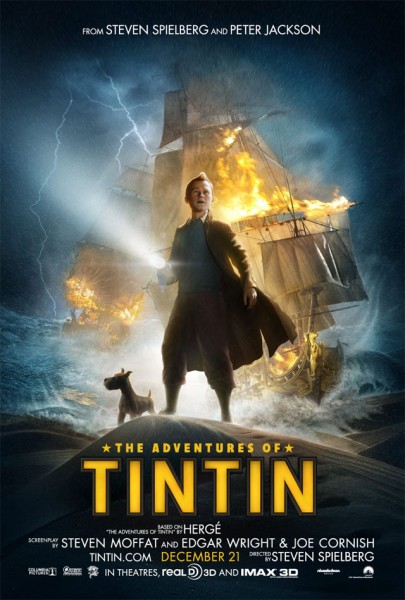
Review: The Adventures of Tintin

The Adventures of Tintin: Secret of the Unicorn
Directed by Steven Spielberg
Starring: Jamie Bell, Andy Serkis, Daniel Craig
Grade: B


If there’s a filmmaker more closely associated with the art of nostalgia than Steven Spielberg then his name eludes me. J. J. Abrams’ “Super 8” was an attempt to wrestle sentiment from Close Encounters and E.T. but, as “The Adventures of Tintin” proves: only Spielberg knows the workings of his own ouvre. When this project came to light the assumption that it would be a live action adventure was quickly hushed by an announcement that this was to represent this director’s first foray into the realm of animation. The finished product is somewhere in the middle of both, with the use of motion capture technology providing a hybrid clash of cartoon action and human instinct.

Hergé’s Tintin books are beloved in Europe, where they’ve gained more exposure, and where the continental sensibilities of this crime fighting, globe-hopping hero have more obvious appeal. The African country of Morocco is the destination for “Secret of the Unicorn,” which sees Tintin (Bell) as an already-established sleuth drawn into the mystery of the Haddock family, and the lost cargo of their long-since sunken ship. Accompanied by his dog Snowy he encounters one of their descendants, Captain Haddock (Serkis), but is continually thwarted in his mission of retrieval by the vengeful, greedy aristocrat Sakharine (Craig).

There’s a delicacy to Tintin as a character which makes him seem knowing, but an ultimate show-off, and it’s this vague arrogance that allows for the key elements of the quest to be outlined to an infant audience. As is the case with so many mystery stories aimed at kids (Nancy Drew, The Famous Five etc.) the story hinges on foreseeable plot points, which frequently feature objects or clues as the catalyst for revelations. And still, the thoughtful approach towards themes of heritage, kinship, and masculine inadequacy (there are barely any women in this film) extend “The Adventures of Tintin” into universal territory. In the mould of “Raiders of the Lost Ark” Spielberg shifts the dramatic onus upon uncovering historical truths, and uses the exotic setting as a handy platform for action sequences – one particular street chase a marvel in choreography and execution.


Shifting focus towards a more nautical-themed adventure allows Tintin’s burgeoning relationship with Haddock to take centre stage, and kingpin of the filmmaking medium Andy Serkis to have a ball as the incompetent drunkard with a heart. But ultimately, it’s a shame that Morocco doesn’t greatly contribute to the crux of the mystery, given the amount of television episodes dedicated to interweaving foreign intrigue into the story’s crimes and motives . Moreover, the ending of the film is a tad anticlimactic in the ease at which it shows us what we’ve essentially seen before, and then leads into the promise of a sequel with a very similar goal to this adventure. If the heavily-suggested sequel goes ahead then one expects the follow-up will have to considerably build upon “Secret of the Unicorn,” which lays the groundwork but likely won’t emerge as the model of attainability. It’s stoking the embers rather than blazing the world alight, and setting out its stall for a franchise.

This quirkily-conceived detective adventure meshes well with Spielberg’s cinematic tropes and represents a return to form which – however brief with the hotly-anticipated “War Horse” ready to emerge – will encourage those who had lost faith. It’s worth noting that many of this film’s shortcomings could also be said of the book and TV series adaptation, which itself is a confirmation that Spielberg has done right by this franchise. Some will simply be unable to fully invest in the neither-here-nor-there motion capture technique, but in terms of narrative and character “The Adventures of Tintin” captures the charm of the man, his friends and enemies, and the casual nature of criminal investigation as enlightening, brisk fun. Forget horses for a while, and instead turn your attention to the antics of one man and his dog.

LDN

As it’s been just over a month since my last blog post, I’d like to take this opportunity to state that, yes, I am still alive. If you take a look at the sidebar you’ll notice a section dedicated to the London Film Festival, which I had the pleasure of attending for the first time this year on behalf of InRO, and which has been the chief reason for my absence from the blog during October. I’m going to endeavour to compensate for this by posting full and capsule reviews of several of the titles I saw there in the coming weeks, including highly-anticipated awards contenders “The Artist,” “The Descendants,” and “Coriolanus.”

In the meantime, following this post is a review of "The Adventures of Tintin," which was not a part of the festival, but deserves attention nevertheless.

Wednesday, October 05, 2011

Review: Julia (1977)

Julia
Directed by Fred Zinnemann
Starring: Jane Fonda, Vanessa Redgrave, Jason Robards, Maximillian Schell, Meryl Streep
Grade: B


Fred Zinnemann's "Julia" sure is an odd duck. It's so odd that it doesn't feel like Zinnemann made it at all -- less formal  and glamourous than his Fifties' work, quirky and clunky as if Frank Perry or Jerry Schatzberg were at the helm. It's set during the war but you rarely think of it as a period film, of-the-time in its quadrant of uncertainty and incoherence yet stylistically appealing in its lack of an assured gaze. Based on the memoirs of playwright Lilian Hellman there's a distinct impression that this passage of her history represents but a misty swarm of ideas and feelings within the book, which is a sentiment that's echoed onscreen.

"Julia" is a rare period drama where you have to put in nearly as much as you get out. Lilian and Julia enter the film with a childhood bond that permeates the surface of mere adulation into something more spiritual and undefined, a couple of early sequences dedicated to hints of exposition. Alvin Sargent's script then lurches forward to a fag-chuffing Jane Fonda looking stressed at her typewriter, and a stately Jason Robards as her friend and advisor Dashiel Hammett. Lilian is marooned in her beach house and grasping for inspiration, precluding an outside world which is coming to terms with major political unrest. While Julia participates in resistance projects, Lilian approaches the global situation with her words, thoughts, feelings, and indelible ink.

There are so few passages in which we're told what somebody is thinking or feeling, or made to sympathise with one political cause or another -- even as a fascist-set drama rightly never has to justify lambasting its subject matter. We're making sense of the characters and what they represent, but we aren't following them like puppy dogs. We merely watch while events revolve around them, and observe their fragmented distillation of fear. This isn't a smooth, linear story of arcs and lessons -- it's an oscilloscope of connection-through-disconnection, and a portrait of how one's life isn't so designated and remedial a journey. How we're indecisive, wary, blameful, duly responsible, even as what goes on around us feels so unapproachably abstract. The fate of the writer is perhaps an even bigger burden; what is progress without improvement, enlightenment, and approval? What are we without labels or goals?

At least in terms of dialogue none of the characters fully address these conflicts, and one scene in particular demonstrates how the script doesn't need to preach to transfer its thoughts. Sat in a German bar Lilian eventually makes the gruelling trip to Julia's hideout, where the two discuss what Julia has been doing in their period apart. As is in the scheme of Zinnemann's storytelling there isn't a lot of detailed information, but instead he presents a reunion that speaks volumes without having to cause a commotion. With lesser actors it's difficult to see this five-minute setup providing such a wealth of emotion, but because it's Redgrave and Fonda we get it all. Redgrave in particular has the uncanny ability to provide magnetic presence without appearing at all aware of the camera, and the nature of Julia as unconcerned with anything but her own passioned intentions lets us see her on the otherworldly pedestal Lilian builds for her. 

Zinnemann insists on harking back to one lingering point of recognition: a shot of the sun setting on the sea and an unmanned boat (Kim Ki-Duk-style) in what's probably an overly poignant way of rooting us in Lilian's lost world of the writer. We're often left too entrenched in this pocket of uncertainty that the film lacks a certain level of scope and sense of the period, but it's forever enchanting and deep in maturity. "Julia" is a hotchpotch of unfocused archives amidst one woman's attempts to reconcile herself with a conventional point of meaning. Ultimate accomplishment may inherently elude this film, but bully for those involved that it manages to be as bracing as it is without succumbing to staples of the biographical drama.

Thursday, September 29, 2011

Review: Sennentuntschi

Sennentuntschi: Curse of the Alps
Directed by Michael Steiner
Starring: Roxane Mesquida, Nicholas Ofczarek, Andrea Zogg, Carlos Leal, Joel Basman
Grade: C


‘Hell hath no fury like a woman scorned’ is a proverb that plays a prominent role in Michael Steiner’s tongue-twister horror title “Sennentuntschi.” Having recently had its UK premiere at burgeoning horror festival FrightFest, the mythological elements of this chilling, religious shocker are promoted through titular add-on ‘Curse of the Alps,’ which helps to cement the feeling that the supernatural will feature heavily in the drama. In this regard “Sennentuntschi” does not disappoint, offering a uniquely deranged brand of melodrama, and a plot that embraces wild abandon.

Beginning with the grizzly discovery of a skeleton on a mountainside, "Sennentuntschi" flashes back to detail the whos, hows and whys behind the death of this person, and the nature of their presence in a small village in 1975 Switzerland. Keen to ante up the drama early on, this retrospective switch features an immediate introduction of conflict, one of the priests at the local church discovered hung from the bells in an apparent suicide. For the religious inhabitants of this place a man of the cloth taking his own life bears serious implications, and so the tiny populous seek to discover how this has happened, and to indict the evils behind it.

When a villager spies a mysterious young woman roaming the woods a search brings her back to the town, where the reluctant agreement is that she is an outsider here by chance. After the local Sheriff Sebastian fetches her back to the home of the Mayor, Sennentuntschi attacks his pregnant wife in a fit of panic and runs off into the mountains, prompting the villagers to assert that she is a demonic presence in their haven, and to seek out the young woman and bring her to justice.

Since back in the days of "Johnny Belinda" muting female protagonists has proved a handy cinematic device for making male exploitation appear even more deplorable. Sennentuntschi exhibits the signs of stunted social development and a lack of emotional maturity (the reason for this is later revealed) appearing as mythical and androgynous a figure as Sci-fi badass Summer Glau in "Serenity." There's something dangerous about the way Mesquida stalks this mountainside town, and Steiner promotes her as a form of mythological being, judging all around her with instinctual verve rather than adhere to the ideological framework of this place. Partly through shunning perceived "normalities" of this religiously fanatical paradigm, and partly due to emerging in the wrong place at the wrong time, Sennentuntschi finds herself hunted down, but still treats this town as her natural habitat.

Monday, September 26, 2011

First Oscar Predictions for 2011

Last Friday's release of Tomas Alfredson's "Tinker, Tailor, Soldier, Spy" was significant in more ways than one; not only is it an accomplished and riveting piece of work, it's the first major Awards-focused contender to be released this year. That's not to say that those out for a while (at least Stateside) such as "Midnight in Paris" and the audacious "The Tree of Life" aren't in the conversation for Oscars -- just that they understandably didn't position themselves in prime Autumn/Winter calendar spots.

With the Venice and Toronto festivals now over, and a mere two weeks until London's own showcase kicks off, it seems as good a time as any to dole out some tentative predictions for this year's Oscar nominees, announced in January. The next couple weeks see hopefuls like "Warrior," "Melancholia," and "The Help" released on UK shores, while the rest of the year features new work from Steven Spielberg, Alexander Payne, and Clint Eastwood.


Here is how I currently see the races shaping up:


Best Picture


"The Artist"
"The Descendants"
"Extremely Loud and Incredibly Close"
"The Help"
"J. Edgar"
"War Horse"

On the Outside:

"Tinker, Tailor, Solider, Spy"
"Midnight in Paris"
"Moneyball"
"The Tree of Life"
"We Bought a Zoo"


Best Director


Clint Eastwood, "J. Edgar"
Michael Haznavicius, "The Artist"
Terrence Malick, "The Tree of Life"
Alexander Payne, "The Descendants"
Steven Spielberg, "War Horse"

On the Outside:

Tate Taylor, "The Help"
Stephen Daldry, "Extremely Loud and Incredibly Close"
Woody Allen, "Midnight in Paris"
Cameron Crowe, "We Bought a Zoo"


Is the "J. Edgar" trailer that bad? Personally, I don't think so. Di Caprio seems to be staying within a comfort zone, but that isn't surprising; it looks formal and business like, but that isn't surprising. When faced with political dramas it seems more likely to me that the Academy would choose "J. Edgar," a film about American politics and a prominent figure in particular, than the subtle aloof intricacies of Tomas Alfredson's "Tinker, Tailor, Soldier, Spy," which is more arty and hard work. The odds on Eastwood's film being better are fairly slim, but otherwise nothing suggests to me that it isn't in a strong position going into the end of the season.

As the only one of these currently released "The Help" already has the mark of success, with decent critical praise, a ton of public approval, a handy mixture of light and shade to detail the Academy-friendly topics of race and prejudice. I really can't see it missing out given all of these collective factors. "The Artist" and "The Descendants" appear to be the titles exiting festivals with the biggest buzz, while Steven Spielberg's "War Horse" has the huge Pullitzer pedigree, a World War II setting, and a 'horse and his boy' story.

The wildcard pick here is "Extremely Loud and Incredibly Close," which reads on paper as fairly schematic and soapy, but it's written by Eric Roth of "Benjamin Button" approval and has an impressive cast. Lingering on the outside (this could be a list encompassing anything from five to ten nominees, remember) are the two aforementioned early-year releases by Woody Allen and Terrence Malick, both of which have many supporters and could emerge should some of those December titles falter.


Best Actress in a Leading Role


Glenn Close, "Albert Nobbs"
Viola Davis, "The Help"
Felicity Jones, "Like Crazy"
Meryl Streep, "The Iron Lady"
Michelle Williams, "My Week With Marilyn"

On the Outside:

Charlize Theron, "Young Adult"
Keira Knightley, "A Dangerous Method"
Rooney Mara, "The Girl with the Dragon Tattoo"
Elizabeth Olsen, "Martha Marcy May Marlene"
Kirsten Dunst, "Melancholia"


Beyond Meryl Streep and Glenn Close, who have been hogging most of the buzz even as few people have seen "Albert Nobbs" and almost nobody has seen "The Iron Lady," this category looks to be up-in-the-air. All of the perceived main contenders have detractors: in the case of Jones and Olsen being unknowns in small, critically well-received dramas, in the case of Mara a film and persona that looks too dark and off-putting for the Academy, and in the case of Knightley divisive reviews on whether her performance hits or completely misses.

I toyed with including Knightley and Theron, who at least have been here before, but with "A Dangerous Method" seeming to lose buzz and "Young Adult" a complete unknown quantity at this stage, I decided to leave them out for now. "Like Crazy" has been building word since Sundance and Felicity Jones is an extremely likable actress in a baity role, so I could easily foresee her campaign getting stronger through the Autumn. Michelle Williams' fate is more difficult to predict, since people don't seem to be on board with her or the film at all, but once the reviews start spilling out there could be a nostalgia factor with the media. Especially since Marilyn never got an Oscar nomination herself.


Best Actor in a Leading Role

George Clooney, "The Descendants"
Leonardo Di Caprio, "J. Edgar"
Jean Dujardin, "The Artist"
Gary Oldman, "Tinker, Tailor, Soldier, Spy"
Michael Shannon, "Take Shelter"

On the Outside:

Woody Harrelson, "Rampart"
Joseph Gordon-Levitt, "50/50"
Brad Pitt, "Moneyball"
Matt Damon, "We Bought a Zoo"
Michael Fassbender, "Shame"


It'd take a significant departure from George Clooney's usual middling, wry charm for him to wow me in "The Descendants" but when you're an Academy favourite, you're an Academy favourite, and this is a sympathetic role for him. Ditto Di Caprio, who has to be favourite to win, if only because there's virtually no biopic competition, and the fact that he's regarded as overdue by quite a few. But maybe not quite as overdue as Gary Oldman (certainly if we're talking in the British quarters) and even if "Tinker, Tailor..." contains his most withdrawn and crafted performance it'll probably be enough to get him a nomination for a film that's universally-respected.

From there, Jean Dujardin has the buzz, and if "The Artist" turns out to be the real deal among arthouse audiences and the older demographic then this doesn't seem an unlikely get. Joseph Gordon-Levitt has the guarantee of a well-liked film and the hugely advantageous topic of cancer on his side, but he's still relatively young in terms of Best Actor nominees, so they could easily oversee him for older men in more high profile films -- like Tom Hanks or Matt Damon. But instead I see the fifth nominee being someone like Michael Shannon, who falls somewhere in the middle of all this mix of respectability, prestige, and acclaim. It's still a game of guessing.


Best Actress in a Supporting Role


Jessica Chastain, "The Help"
Judi Dench, "J. Edgar"
Janet McTeer, "Albert Nobbs"
Vanessa Redgrave, "Coriolanus"
Octavia Spencer, "The Help"

On the Outside:

Melanie Laurent, "Beginners"
Jessica Chastain, "Take Shelter"
Carey Mulligan, "Drive"/"Shame"
Marion Cotillard, "Midnight in Paris"
Shailene Woodley, "The Descendants"


Maybe I'm overestimating "The Help" a touch but I'm still confident about its chances across the board. Octavia Spencer and Jessica Chastain both have roles as the funny, caretaking black woman and the ditzy white woman who confounds common stereotypes of her race. Chastain has too many films out this year when you consider how difficult it is for a new-on-the-scene actress to build an awards campaign with one film these days. But the performances themselves have been so well-liked, and this film is so well-liked, that this could legitimately happen for her.

Vanessa Redgrave's continued great notices for Shakespearian drama "Coriolanus" and Judi Dench's surprisingly prominent presence in the newly-released "J. Edgar" trailer both suggest that these perennial women of awards discussion can reappear for (perhaps) final nominations/wins. It's been twelve seasons since Janet McTeer managed her sole nomination for "Tumbleweeds" but a role opposite Glenn Close's cross-dressing butler has since renewed hopes of a second Osar outing. It's a difficult pick to be confident about given that nobody particularly liked "Albert Nobbs" and McTeer's presence doesn't have the comeback factor of her co-star. She could easily be completely overshadowed.

Best Actor in a Supporting Role


Jim Broadbent, "The Iron Lady"
Albert Brooks, "Drive"
Armie Hammer, "J. Edgar"
Tom Hardy, "Tinker, Tailor, Soldier, Spy"
Christopher Plummer, "Beginners"

On the Outside:

Nick Nolte, "Warrior"
Philip Seymour Hoffman, "The Ides of March"
Ben Kingsley, "Hugo"
Christoph Waltz, "Carnage"
Kenneth Branagh, "My Week With Marilyn"


I nearly predicted the popular Christoph Waltz, since he's been singled out as the best of the "Carnage" ensemble and may be becoming known as one of those reliable 'supporting' players after his Oscar win in that category, but ultimately "Carnage" doesn't look as if it's going to be the major contender it promised to be. The only solid reviews so far have been for Albert Brooks, Christopher Plummer, and Nick Nolte - the latter of which could easily make the five but who is in a film which, ironically, doesn't look as if it's going to last the distance.

Tom Hardy gives the second best performance in Tomas Alfredson's slow-burning espionage thriller (no mean feat!), but faces internal competition from Benedict Cumberbatch; Jim Broadbent is surely going to be stellar as the baity husband of Meryl's Thatcher, and if that "J. Edgar" trailer emphasises anything, it's that Armie Hammer is going to get more to do than afforded him in "The Social Network."


Best Original Screenplay


"The Artist"
"Beginners"
"J. Edgar"
"Midnight in Paris"
"Win Win"

On the Outside:

"Young Adult"
"Like Crazy"
"Bridesmaids"
"Take Shelter"


Best Adapted Screenplay


"The Descendants"
"Extremely Loud and Incredibly Close"
"Moneyball"
"Tinker, Tailor, Soldier, Spy"
"War Horse"

On the outside:

"The Help"
"We Bought a Zoo"
"The Ides of March"
"A Dangerous Method"

Monday, September 19, 2011

Bitesize Best Actress Oscar Profiles: Janet Gaynor

Janet Gaynor in "Street Angel"
Won the 1927-28 Best Actress Oscar (Also for "Seventh Heaven" and "Sunrise")

Grade: ****


Firstly I have to confess to being inexperienced with regard to silent films. The vast majority of those that I have seen were forced upon me as part of university modules, and subsequent attempts to watch renowned classics (Battleship Potemkin, Broken Blossoms etc.) have resulted in abandonment. For some reason it requires more effort for me to watch a film without audible dialogue than it does for, say, a film in which the dialogue is spoken in Greek or Russian. After watching “Street Angel” I feel even more bashful about my behaviour, since it exhibits many of the most appealing features of silent cinema; foremost, the wonder of visual storytelling, and also the way in which it manages to create a score that reflects the emotive shifts of the action on screen.

Janet Gaynor is most famously the Actress to win for not one, not two, but three performances in films made between 1927 and 1928 – one of the early anomalies that make Oscar statistics a pest to compile. While lovely in “Sunrise” the film and performance failed to bowl me over, but the situation is somewhat different with Frank Borzage’s “Street Angel,” a social commentary involving a woman driven to commit a crime through desperation, and blighted by that crime later in life. Borzage and Gaynor had a healthy relationship (he made two of the three films which garnered her triple Oscar win) and her presence on-camera is one that shows complete faith between director and performer.

While the film moves at such a rapid pace in the first twenty minutes this is mainly in order to outline the predicaments of Gaynor’s Angela, who deals with familial strife and a run-in with the law. Her brush with criminality forces a shift from the unassuming, loving daughter to a more hardened, downbeat view of the world, exacerbated when she runs off with a circus troupe and becomes a star there. Gaynor reveals Angela’s attitude towards men as distrusting and contemptuous through brazen dismissal of anything mushy and sentimental, and even if Borzage is far too eager to race to Angela’s romance with incoming vagabond painter Gino then Gaynor at least bridges the gap between the reserved contentment that dominates her character.

As a victim of poverty and what’s perceived to be society’s neglect of the working classes, Gaynor sustains a level of grace which gives the internal conflicts of Angela all the more eminence. In the film’s most testing plot device she escapes from her imprisonment at a workhouse in an unlikely reversal of fortune, the moment at which she is provided with a path to freedom handled with disbelieving trepidation. In theory this is as much of a moral decision for Angela than the act which initially landed her in hot water, and Gaynor palpably details the confluence of ethical and physical necessities in her character. This whole sequences takes up less than five minutes of “Street Angel,” but you somehow feel like Angela has been without her civil liberties for far longer.

Occasionally Gaynor may too adamantly telegraph emotional pining by exerting gestures of physical pain, and for substantial periods she’s re-iterating Angela’s heartache and shame when confronting men who expect better of her. But Gaynor does this with such operatic verve and introspective worth that “Street Angel” constantly flourishes under her careful guidance as a lost yet fascinatingly self-aware protagonist whose motivations derive from passion and love. A hard-hitting, perfectly pitched scene in which she finally addresses the implications of her actions lend Gaynor the opportunity to be particularly devastating in reaction to the reality of losing what’s close to her, and she certainly does not disappoint.

By all accounts, word seems to suggest that Gaynor was one of those actresses who somewhat lost out as a result of the advent of talkies, despite a 1937 nomination for the William Wellman-directed “A Star is Born.” She’s fine as Vicki Lester, but less impacting than in “Sunrise” and especially lacks the depth of feeling of this performance, which permeates so well as an embodiment of the social victim. Having seen two of Gaynor’s ’27-’28 triple-threat of pictures the jury’s still out as to whether her and Borzage are a marriage made in (Seventh) Heaven, but based on the resounding success of their partnership here, I wouldn’t bet against it. Keep an eye on the sidebar this coming week for a peek at whether she can make it 2 for 2.

Thursday, September 15, 2011

Review: Villain (2010)

Villain
Directed by Sang-Il Lee
Starring: Eri Fukatsu, Satoshi Tsumabuki, Akira Emoto, Hikari Mitsushima, Masuo Keijo, Kirin Kiki, Masaki Okada
Grade: B

 
Japanese director Sang-Il Lee has seemingly decided to follow in the footsteps of his Korean peers with new murky crime thriller, "Villain." The film, about an unhinged young man's approach to sexual relationships, emulates the recent works of Bong Joon-ho and Lee Chang-dong - "Mother" and "Poetry" respectively - in so much as it details the impact of crime on the families of said criminals and where the blame behind their deeds resides. As a part of recent attempts to address the social and contextual factors attributed to spawning criminality, one would tentatively describe "Villain" as part of a cinematic trend, and foremost an indication that Asian cinema is providing alternatively rich perspectives on perceived societal evils.


When we first spy petrolhead Shimizu (Tsumabuki) he’s loitering at a gas station and looking thoroughly bored with existence. While he doesn’t loom as a particularly dangerous figure, his presence intimidates through what appears to be an ambivalent disassociation with his surroundings. This young man is an emotionless wildcard. And as we follow him on his journey to meet popular college girl Yoshino (Mitsushima) his thorough lack of belief in either himself or anyone else quickly comes to the fore. The night does not go well for Shimizu when Yoshino spurns his advances and takes off into the sunset with her local crush Masuo, and the discovery of her dead body the following morning raises serious questions. Is Shimizu the prime suspect in her murder?

The ensuing conflicts are separated between Shimizu confronting his involvement in Yoshino’s final hours, and the grief-stricken parents of the girl trying to gain perspective on how and why she died. When Shimizu is hunted down by police he flees home, aided-and-abetted by Mitsuyo (Fukatsu), a girl he met just days earlier in a random internet meeting. As his situation becomes increasingly precarious he and Mitsuyo develop a strong attachment, which leads them to go into hiding from the law and the world.

"Villain" achieves much emotional heft through its construction of Shimizu and Mitsuyo, two central characters with an inherently awkward lack of social skills and self-worth. Theirs is a connection founded upon solitude and necessity, both exhibiting impulsive and wildly off-kilter relationship ethics through having so far lived modest, sheltered lives. You can gauge a significant sense of backstory from even their first five minutes together, as they murmur sheepishly in a car with little sense of how to build a dynamic or engage beyond pleasantries and eventual physical gratification. Founded upon this partnership “Villain” succeeds as an interconnected would-be Shakespearian tragedy, very much a fresh take on the emotive aggression of youth but possessed with the bitter melancholia of classic works.