
Jill Clayburgh in “An Unmarried Woman”
Lost the 1978 Best Actress Oscar to Jane Fonda in “Coming Home”
Grade: ***
If the sixties were all about the burning of bras and the breaking of boundaries, the seventies were more about re-evaluating relationships, gender roles, and the institution of marriage. Paul Mazursky, the helmer of wannabe-swinger comedy “Bob & Carol & Ted & Alice,” clearly had a lot to say about monogamy, returning nine years after that Oscar-nominated ensemble piece to write and direct “An Unmarried Woman,” about a housewife dealing with her husband’s decision to leave with another woman. Contrary to this period’s popular representation of women in relationships as mopey and often hysterical, Mazursky’s principal character Erica is a looser and more independent specimen when given the heave-ho. More associated with TV than film, Mazursky hired Jill Clayburgh as his plucky leading lady, a move which proved to pay dividends for both of them.
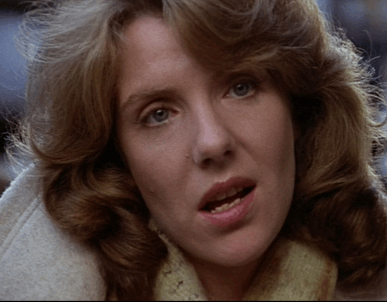 |
| Jill Clayburgh's reaction to her husband's confession. |
It’s little surprise that Clayburgh’s performance gathered so much love the year after Diane Keaton’s win for “Annie Hall”: there are many similarities to the free-spirited approach of the two characters once Erica breaks away from her jilted lover depression. With Annie it’s an ideology; with Erica it’s a defence mechanism, but both exhibit that façade of fleetiness which attracted so many cineastes of the moment. Although the humour can get very dry, Mazurky’s script has an uncanny knack of making Clayburgh’s many exchanges with questionable, erudite men feel adult and involving, and even when the actress is required to resort to insolent standoffishness she brings a wry, half-resigned tone which can gel with her director’s comic intentions.
“An Unmarried Woman” always regards Erica’s arc as its driving force, and in portraying such a scrutinised personality Clayburgh feels the burden of carrying this journeywoman heft through to a climax. Nor does she deal very well with the crucial reaction scene, responding to her husband’s confession of love for another woman with simmering hurt but no concrete, impacting sense of introspective turmoil, and the payoff line that Mazursky gives her (however misjudged) goes down like a lead balloon. At key moments Clayburgh treats the character analysis with lighter fervour than needed to plumb the depths of bitterness in Erica, more gamely and sprightly than mournful or contemptuous. One wishes that Clayburgh would distillate more of that steely verve into tangible heartache, rather than throwaway flickers of combat.
There are glimpses of the spirit of Carrie Snodgress’ nominated performance (in “Diary of a Mad Housewife”) referenced here, albeit with scepticism more vocalised than internalised, and with a considerably better sparring partner in Alan Bates to work with than Snodgress had with Richard Benjamin. If Erica feels predisposed to sympathy, neither Mazursky nor Clayburgh use this as a disclaimer for her actions, and despite this she often colours Erica’s progressive approach to relationships with hues of vital self-motivation. Crucially, for a film entwined in critiquing its era’s societal norms, Clayburgh’s showing hasn’t aged so badly, and she relays the assertion of “An Unmarried Woman” that to be “unmarried” is not to be “unhappy,” with admirable care.


