Monday, August 22, 2011

Review: Cold Fish

Cold Fish
Directed by Shion Sono
Starring: Mitsuru Fukikoshi, Denden, Megumi Kagurazaka, Asuka Kurosawa, Hikari Kajiwara
Grade: C+

Written for In Review Online:


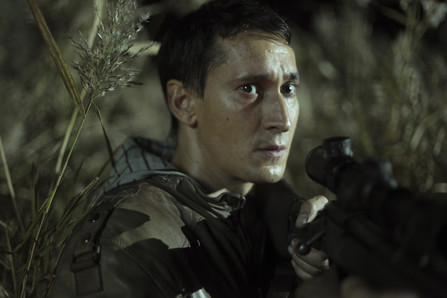
Although the term ‘sleep with the fishes’ was popularised by “The Godfather” and remains synonymous with gangsters today, rarely does a crime thriller go so far as to work aqua life into its thematic makeup. Shion Sono’s “Cold Fish,” making its way into U.S. theatres nearly a year after it premiered in Venice, utilises this somewhat idiosyncratic metaphor in telling an essentially familiar story about the grubby underworld of the Japanese Yakuza. If there’s much in Sono’s film decidedly designed to rock the boat, there’s enough comic irony in the whimsically-surfaced profession of the tropical fish salesman being used as a cover for murder, greed, and betrayal.

Against all odds, this vocation is seen to be a heinously viable one, as the unassuming aquarium enthusiast Syamoto learns when he accepts the help of Murata, a worldlier kingpin of the industry. Murata enters the film as a gentle giant, handing Syamoto’s daughter Mitsuko employment and accommodation as an apparent moralistic reaction to the girl’s attempted shoplifting of an item at his store. Concern is triggered into Syamoto with every passing increase of involvement Murata poses in their family dynamic, particularly taking an interest in his wife Taeko, and he’s finally shackled by the revelation that this jovial figure is a vendor of more than pets.

Sono relays the tone of the film through the figure of Murata, who evolves from acquaintance to friend, to partner, to sociopath, to psychopath in a fairly short space of time, and is aided by the maniacal display of prolific actor Denden. His loopy mannerisms and extrovert behaviour completely align with the absurdity of a script which has few narrative surprises but plenty of murky characterisation. It’s strange to witness such a licentious community appear as gleefully profligate in their behaviour as Murata’s irksome troupe, who swap sexual partners daily and revel in dissecting corpses over a cup of coffee. Sono’s deviant representation of them eventually tires with Vampira-style segments of women French kissing in doorways, but for the most part the quirky beats and rhythms of this organisation strike a chord.

But all this comes from a film which technically has the same plot as "Wall Street," albeit with an alternatively volatile resolution. It's less suited-and-booted than bloody and berserk, but nevertheless imparts a familiar impression of mentoring through intimidation and fear. Murata and Syamoto’s relationship, while exercised to extreme degrees of dominance and submission, doesn't offer a different power struggle than we're used to seeing in films where the emphasis is placed upon enforced corruption and breeding criminality, and Sono harvests the notion that amorality is contagious without saying much more. Most of the charms of “Cold Fish” lie in Sono’s novel stylistic flourishes, and in the hazardous hues of Shinya Kimura’s grim cinematography.

“Cold Fish” treads the age-old Duality of Man path, unevenly skewed towards using this to generate grotesque horror. Syamoto’s arc is far too extreme for the film’s conceit to work on a profound level, since we only truly empathise with him in the less concisely-characterised scenes, which are few and far between. He’s the only character we’re required to take seriously and yet Fukikoshi’s performance so dominantly comprises of two erratic, forced gears, that it’s a serious stretch to believe him at all. Moreover, the dynamic of this family is lost in the way that Sono spells out the undertones of discontent with talk of backstory, reluctant to show us how Syamoto’s relationship with his wife and daughter relates to the transition of their social situation. There aren’t enough equilibrious examples to support the actions of the final act, and instead much of the action is consigned to repetitious acts of violence, and noir-esque showdowns – neither of which contributes to the humanist angle Sono races toward.

Admirably, a revenge theme lurks in the outback of “Cold Fish,” and can’t really be called a primary motivation of Sono’s action cinema – different, certainly, from 21st century Asian cinema tropes. For a while it even feels as if there are more ambiguous intentions to our hero, and the stressful gauntlet he’s subjected to. The path of this drama so uncontrollably derails into sensationalist territory without earning our understanding, and rather than feel the impact of a bitter finale we’re left to pick up the weary pieces of an explosion too rashly orchestrated. In 2008 Sono’s “Love Exposure” took four hours to sit through – couldn’t he have found more patience in concluding this portrait of unruly society?

Up to and including a shaky finale “Cold Fish” imbues danger and flair without really sustaining the core of its commentary on strained relations and an inherent strive towards fulfilling the many hues of one’s personality. And still, there’s something to be said for a film that can be slow-burning and thoroughly rabid and larger-than-life at heart. While widely asserted that blood is thicker than water, "Cold Fish" proverbially screams that actually, no, it isn't.

Wednesday, August 03, 2011

Review: Pigs and Battleships (1961)

Pigs and Battleships
Directed by Shohei Imamura
Starring: Hiroyuki Nagato, Jitsuko Yoshimura, Masao Mishima
Grade: A-

Written for Subtitled Online:


It might not come as a surprise to reveal that the pigs in Shohei Imamura’s curiously-titled “Pigs and Battleships” are as metaphoric as they are literal, their use as a ruse for shadier business a more-than-scathing attack on the invasion of Americanised ideology within Japanese culture. The country’s well-documented tense relationship with World War II enemy America was an ultimately destructive affair, culminating in the now-infamous atomic bombings on Hiroshima and Nagasaki. Made in 1961, “Pigs and Battleships” depicts a period of eerie aftermath and cultural rebirth within Japanese society, and its adoption of a way-of-life which cultivates corruption, greed, and disloyalty.

As U.S. G.I. soldiers stop off at the Japanese harbour town where young, plucky Yakuza member Kinta (Nagato) resides, local women are plied with booze and pimped out by the authorities. While Kinta remains in charge of the local pork farming business, this is largely a cover for the power-political schemes of the town’s mobsters, who are vying with rival gangs and trying to keep officials sweet. Difficulties arise when the corpse of a local businessman is washed up on the shore, forcing the gang to deal with investigations into his disappearance and manage conflict within their organisation.

Despite Kinta’s enthusiasm for his peers his girlfriend Haruko (Yoshimura) struggles to deal with the dangerous nature of the world he has entered into, and encourages him to get a stable, straight profession. This disagreement causes a fierce rift between the couple, forcing them to escape their relationship in extreme ways, and casting into doubt whether this is the right place for them to begin their life together. Kinta himself learns that being part of the Yakuza has its distinct downfalls as well as its benefits, as many of his colleagues are keen to see him sacrificed for the greater good of the unit.

From the outset Imamura presents a glamourised impression of this town, which, with its cultural hybridism and willingness to embrace commerce, feels like it should be on a border between two states somewhere. There’s an element of Welles’ “Touch of Evil” in the way brass accompaniment and sweltering, smoky streets dominate the films’ opening, demonstrative of the thriving success of capitalism. Kinta’s pride in an early scene stresses the self-sufficient and morally-shy philosophies of a community reliant upon mutual exploitation, and a crisis of identity which reflects the director’s commentary on the disarray of the country’s hierarchal workings. These residents are governed by foreign money, and he does little to hide the characters’ motivation to aspire towards American values, caught up in a cycle of self-preservation and armed with a thirst to succeed.

“Pigs and Battleships” balances the crime and romance within the narrative supremely and shrewdly manoeuvres the journey of its characters to align with grander political concerns. Partly due to the off-kilter, occasionally infantile performance of leading man Nagato, Kinta isn’t always so relatable as a protagonist, but although he doesn’t encounter many overt threats in the film we still care about his tempestuous attachment to the feisty Haruko. Jitsuko Yoshimura, as a woman going out of her mind with worry and disillusionment at the people around her, is such a fascinating Actress, and in a similar way to Janet Leigh in “Touch of Evil” captivates by being the victim that never learns to keep quiet, die down, or give in. At some point in the midst of the film Haruko becomes its emotional centre, her fragility mirrored in the film’s sharp decline towards hysteria and unrest. As she grows to be consumed by resentment and unworthiness “Pigs and Battleships” is best served from her perspective, its second half a more sprawling story of Noir cinema’s easy dismantling of perceived strengths and friendships. A subplot involving Yakuza kingpin Sakiyama also stresses the feigned sense of grandeur that comes with the luxury of power.

“Pigs and Battleships” admittedly piles on the metaphors too flagrantly (particularly towards the end) in a finale that echoes the best and worst of Kubrick, opting for cavalry band-style music to accompany catastrophe in the way that Mickey Mouse Club booms out in 1987’s “Full Metal Jacket.” It’s a minor foible since the script exhibits such a breadth of allure – from intricate melodrama to fiery romance to ironic genre subversion – that the aesthetics going on around it merely form another layer to the avalanche. In aping a Noir structure Imamura approaches the common issue of small-town trappings with authorial verve, offering a spectrum of his setting which veers between appealing mystery and strenuous squalor.

While many of the characters on display here are essentially on a hiding to nothing, the same cannot be said for this film’s ambitious creator. “Pigs and Battleships” landed in Japanese cinemas at the time when the French New Wave and Italian Neo-realist movements were burgeoning, and Imamura’s study of Nationalism and its implication on society bears its own unique stamp, too. Occasionally overcooked, it’s nevertheless an astounding product of impassioned, effective, and thoughtful filmmaking, and finds its own pocket of time and relevance within this auteur’s carefully drawn-out filmography.

Tuesday, July 26, 2011

Does Angelina Jolie Justify Being the Highest-Paid Actress on the Planet?

I've just been getting around to this but earlier this month Forbes released an updated list of Hollywood's highest-paid actresses, and there are a couple of surprises. As well as the usual group of renowned A-list stars from the past five years and beyond (in some cases, way beyond), there are three former TV stars and a woman barely over twenty.

It isn't really surprising to learn that Angelina Jolie tops this list, earning a staggering $30m a film. Everything she's touched lately -- from animated blockbusters to Summer action movies to period dramas -- has turned to gold. Even her 2007 biographical indie, "A Mighty Heart," a film that's heavy and relatively unforgiving, managed to make a slim profit. It's somewhat more surprising that Jolie shares first-place with Sex and the City's lead Sarah Jessica Parker, whose two TV-to-cinema projects made New Line a ton of money. To me this seems a somewhat inflated figure for an Actress who has made just eight films in the last nine years (two are scheduled for late 2011) but I suppose this represents her as someone presently sought after.

So too of-the-moment is Kristen Stewart, in the midst of filming the massively popular Twilight series, but a proven draw on the Independent circuit as well as the mainstream Tween scene. Rom-com 'Queens' Jennifer Aniston and Katherine Heigl are also in the ten, while the rest of the list largely comprises of women we've seen there before; Nineties babes Cameron Diaz, Julia Roberts and Sandra Bullock still command $15+m a movie, while 62 year-old Meryl Streep is commendably able to cling to the top ten, arguably as popular now as she was twenty-five years ago.


Official Top Ten Highest-Paid Actresses

  1. Angelina Jolie - $30 million p/m
  2. Sarah Jessica Parker – $30 million p/m
  3. Jennifer Aniston – $28 million p/m
  4. Reese Witherspoon – $28 million p/m
  5. Julia Roberts – $20 million p/m
  6. Kristen Stewart – $20 million p/m
  7. Katherine Heigl – $19 million p/m
  8. Cameron Diaz – $18 million p/m
  9. Sandra Bullock – $15 million p/m
  10. Meryl Streep – $10 million p/m

I'm not really a fan of this list, so I decided to play around a little and figure out some statistics in order to get a better gauge on who might be doing better with the "limitations" of their salary. I calculated the average worldwide box-office total of their movies (based on the last six released theatrically) and used their salaries to gain a VFM (Value-for-money) percentage. This represents the average amount of money they received versus the average amount of gross their films earned.

Interestingly -- but perhaps not surprisingly -- Meryl Streep offers the best value for money, receiving just 5.4% of the profit her films eventually earn. Considering her salary is three times less than Jolie's this suggests that this figure be representative of the vast inflation afforded to the top four women compared to the rest of the ten. Still, Jolie's films have tended to earn at least $100m more than the others, and so she comes in third place at a tasty-looking 8%. Aniston offers the least value for money at 27.2%, her films mainly romantic comedies with modest (but not exceptional) success.

Ranking By VFM Percentage (Based on last six movies up to July '11)

  1. Meryl Streep – 5.4% ($186.5m)
  2. Cameron Diaz – 7.0% ($256m)
  3. Angelina Jolie - 8.0% ($375.8m)
  4. Kristen Stewart – 8.4% ($238.4m)
  5. Sandra Bullock – 10.4% ($144.7m)
  6. Katherine Heigl – 13.8% ($138m)
  7. Julia Roberts – 14.7% ($136.3m)
  8. Sarah Jessica Parker – 19.4% ($154.7m)
  9. Reese Witherspoon – 22.2% ($126.3m)
  10. Jennifer Aniston – 27.2% ($103m)

I then decided to calculate the average Metacritic score of these films to target which actresses are making more acclaimed films for their lofty salaries. Julia Roberts scrapes a victory here, while Streep and Jolie also figure highly. It should come as a shock to pretty much nobody that Aniston's, Heigl's, and Sarah Jessica Parker's recent filmographies leave a lot to be desired.

Ranking By Average Metacritic Score
(Based on last six movies up to July '11)

  1. Julia Roberts - 63/100
  2. Meryl Streep - 62/100
  3. Angelina Jolie - 61.5/100
  4. Kristen Stewart - 59.1/100
  5. Reese Witherspoon - 49.7/100
  6. Cameron Diaz - 48/100
  7. Sandra Bullock - 44.5/100
  8. Jennifer Aniston - 40.5/100
  9. Katherine Heigl - 40.5/100
  10. Sarah Jessica Parker - 38.5/100

As this list changes throughout the next couple of years it's difficult to see Kristen Stewart not making inroads, considering she has two Twilight movies within the next year and also the anticipated forthcoming adaptation of Snow White. Sandra Bullock has Stephen Daldry's Oscar-tipped "Extremely Loud and Incredibly Close" landing at the end of 2011 and a sci-fi film with George Clooney next year, while Cameron Diaz has a celeb-packed ensemble comedy and a heist caper with Colin Firth released next year. Those two look like safe bets to return.

I don't anticipate many women entering this list; Rooney Mara looks like she's going to become very hot property, and the "Dragon Tattoo" remake will likely be successful, Marion Cotillard is working with Steven Soderbergh and Chris Nolan, and future-Catwoman Anne Hathaway has "One Day" poised to shellshock audiences next month. Beyond these, I'm not sure. Suggestions?

Saturday, July 23, 2011

Trailer Round-Up: Dream House, Drive, Main Street

Never mind "Captain America," "Contagion," and "The Dark Knight Rises," here's three newly-released trailers which promise vastly different things.


Dream House


I'm not entirely sure where to begin with "Dream House" as it does look at least well made. Still, Jim Sheridan is absolutely the LAST director I would have guessed would take on a script of this kind. Maybe "Brothers" was so miserable he had to cheer himself up with some thrills and spills? I'm less worried for Sheridan than I am for the actors. Why are talent like Naomi Watts, Daniel Craig and Rachel Weisz consigned to roles in supernatural horror films? In the case of Watts especially, it reads as a little desperate that she's reverting back to the genre that made her a big deal. She hasn't really had a hit since "King Kong" in 2005.

The worst thing about this trailer is that it gives away an awful lot. Was it really necessarily to divulge key plot shifts like Daniel Craig's identity crisis and his "Are my family dead or aren't they?" dilemma. It's one of the biggest adverts I've seen for the notion of limiting trailers to one minute or less. The best ones are those short, creepy teasers anyway; anyone remember that swing creaking in the trailer for "The Omen" remake?

Drive


By contrast, I'm less bothered about spending two minutes looking at Ryan Gosling, and together with co-star Carey Mulligan it's an altogether more successful example of actors picking interesting projects. The trailer for "Drive" is so exhilarating that it flies by, and the buzz from Cannes for this was immense, culminating in a Best Director win for Nicolas Winding Refn. The only film I've seen about stuntmen is the excellent 1980 comedy "The Stunt Man," which netted Peter O'Toole an Oscar nomination. While that film was more about the movies themselves, "Drive" seems to be crafting a segway for Gosling as an action hero compelled to deal with Carey Mulligan's shady husband. This is a film more likely geared towards box office than awards, but it'll surely help Gosling's bid for a nomination in "The Ides of March," which has already been announced as the opener of this year's Venice Film Festival.

I wouldn't call myself a fan of director Refn; "Bronson" is very incoherent and off-puttingly effusive in its techniques. He does, however, seem to have a unique style of filmmaking, and his projects so far are varied and filled with passion. It might be that he has found the polish to add to the shine -- those final 30 seconds of the trailer really work with the contrapuntal music and systematic editing.


 Main Street


Before I suggest that "Main Street," a film about a waste-disposal tycoon trying to rejuvenate an ailing town, doesn't exactly stoke my embers, let us consider the hilarity of Colin Firth's accent in this trailer. Give Firth props for branching out from that charming, bumbling Englishman persona, but asking him to impersonate a Texan is surely a step too far. Adding the potency of acting legends Ellen Burstyn and Patricia Clarkson is shrewd indeed, and the former at least looks like a fair contender at a nostalgia-driven Supporting Actress nomination come awards season -- if the film happens to get noticed at all.

But doesn't that seem awfully unlikely from this trailer? If "Dream House" gave away a ton of plot information "Main Street" just circles around people giving pained expressions and vague assertions about life and home and belonging and....   Are you still awake? Good, because "Main Street" wants to sell you a film by prefacing each person with "Academy Award Winner" or similar, and doesn't seem concerned with sharing something about the story or the characters. Either that, or it's relying on the return of the long-lost Orlando Bloom to whet our appetite - which is a foolish move either way.


Friday, July 22, 2011

Bitesize Best Actress Oscar Profiles: Jeanne Crain

Jeanne Crain in “Pinky”
Lost the 1949 Best Actress Oscar to Olivia De Havilland in “The Heiress”

Grade: *


Jeanne Crain’s ivory complexion lends itself to “Pinky” about as well as Neville Chamberlain’s trusting nature lended itself to foreign policy – which is to say that even though bombs don’t fall and millions don’t die, “Pinky” and Crain are – on some level – a sorry tragedy of their own. Even if you can sidestep the cosmetic issues of a pale-faced ‘classic’ actress adopting the role of a Negro woman grappling with the implications of her race, Crain’s approach to Pinky doesn’t afford her much shade between resentment and allegiance.

I’m often excusing performers for the ineptness of their film’s production values – be that direction, script, or otherwise – but the blame here can be placed on Crain as much as it can on anyone else involved. “Pinky” isn’t a good film (it’s probably Kazan’s worst), but she badly gauges the arc of the character and struggles with the film’s insistence on offering degrees and variations on prejudice and discrimination. It’s depending on her to carve something linear and concrete out of the roundabout politics but instead she finds the bitter, wronged defaults in Pinky and rolls with them for most of the way. She’s rigid and standoffish in the way that she sleepwalks through the film, acting within the confines of her own ability and neatly – but blandly - delivering the piteous quips she’s given.

So one-track is Crain’s approach that she fails to strike a bond with any of her fellow actors, and is fatefully unable to generate empathy for the troubled heroine. Pinky’s blooming relationship with neighbour Miss Em, for instance, is supposed to represent a transitory period of enlightenment towards her view on racial relations, but all the work in these scenes is done by the ailing Ethel Barrymore. Crain is a stingy performer here, to the extent where you wonder what Miss Em has seen in Pinky beyond diligence and efficiency to warrant penning a last minute will-rewrite in her honour.  When engaging in conversation with her heritage-loving Grandmother (played by Ethel Waters) and understanding love interest William Lundigan, the same colourless surface of acrimony comes out to play, as Crain consigns Pinky to a fixed position of intellectual superiority and mild disappointment.

It isn’t necessarily a question of being amiable; Crain is attempting to embody a woman difficult to like, who is hostile towards threats to her standing and ungrateful in many aspects of her life. Although she is keen to access the sense of injustice in this girl, the snappish, quicksmart ‘qualities’ in her manner are not suited to distilling the gritty social commentary, and even less inclined to richen the would-be-tense dichotomy of this community. Crain’s reward of an Oscar nomination probably derived from her dual work in this and Joseph L. Mankiewicz’s “A Letter to Three Wives” the same year, but collectively it really doesn’t amount to much. If 1949 had looked like a pale Best Actress year Crain hasn’t altered that impression, tossing her own strain of tedious inertia onto an already dispiriting roster.


What say you? Was I too harsh on Jeanne Crain's abilities here? Is she merely scuppered by the film's other elements; or is she so at fault that one star reads as generous?  Speak up!

Saturday, July 16, 2011

Bitesize Best Actress Oscar Profiles: Irene Dunne

Irene Dunne in "I Remember Mama"
Lost the 1948 Best Actress Oscar to Jane Wyman in "Johnny Belinda"

Grade: *

After four nominations in eight years Irene Dunne had to wait another eight to grab her fifth and final one, as the Norwegian matriarch in George Stevens' "I Remember Mama." The film was such a smash with the Academy that it managed four acting notices: Oscar Homolka, Ellen Corby, and Barbara Bel Geddes completing the quartet. Even if none of these performances are individually exceptional, the ensemble forms a strong family dynamic – surely the basic requirement for a film which so staunchly promotes cohesion within the home.

Some might call this Dunne's Hollywood swansong (she made three modest features films after this one) and she certainly radiates that veteran Actress vibe in a way that puts her stuffy showing the previous year in Michael Curtiz’s "Life with Father" to relative shame. The screenplay idolises Dunne's Mama as the Mother of all mothers; a woman struggling to feed her kids properly but whom somehow finds a way to make them all happy, and whom sacrifices her own miniscule pleasures for – among other causes – the sake of daughter Katrin's stage play, and son Nels' desire to go to high school.

Dunne’s perennially-likeable persona is at least present here, in the confines of brave-faced solemnity, and particularly flickering in many of her scenes with the adoring Katrin. It’s the centrally resonant relationship in the film, as Dunne telegraphs Mama’s identification with her plucky, spirited daughter with knowing reverence. She recognises what it means to dream about a better life, and – to some degree – how it feels to achieve it, and allays the film’s emulsion of heritage with able aim. The difficulty for Dunne is that Mama is too manifestly disciplined and wise. She feels bound by the expectations of reliability the film generates for her character, and assumes a role we’ve essentially seen countless times before, in an imitable stab at matronly, Beulah Bondi-style emotional distancing.

Dunne digs out dulcet, groaning tones for her Norwegian accent, skipping prepositions to show that Mama hasn’t quite grasped the English language, and phrasing consternation with low-pitched mechanics.  Call it painting by numbers if you will, but for lengthy periods she doesn’t have much of a choice but to dot the 'I's and cross the 'T's of the script, and its crystallised view of foreign settlers as humble family folk with little else to worry about besides holding onto what they have. There just isn’t much to “I Remember Mama” or Mama herself to coax Dunne out of facile, forlorn gestures towards her warring relatives and angst-ridden children, effective in a scene where her daughter retrieves her pawned brooch, but reluctant to give the character any edge.

Dunne isn’t the only person guilty of picking such uniform family drama scripts; “I Remember Mama” and “Life with Father” represent some of the worst work of their directors George Stevens and Michael Curtiz too. While Stevens attempts to rescue his through cavernous camerawork, Dunne does what comes natural and foists the saintly nature of Mama’s firm maternal instinct with delicate charm. For Mama to be a success, she needed someone like Anna Magnani to grab her by the scruff of the neck and add some slovenly realism to her statuesque frame. Instead we get an Actress skating on broodier ice than she’s used to, and opting for single axels rather than triples.

Wednesday, July 13, 2011

Review: Unmistaken Child

Unmistaken Child
Directed by Nati Baratz
Starring:
Tenzin Zopa, Tenzin Nyudrup

Grade: B

Written for Subtitled Online:

The tacit interaction in “Unmistaken Child” paves the way for ultimate success – what isn’t spoken isn’t real. The difficulties associated with faith may appear to vary from religion to religion, but the essence remains the same: sacrifice and duty rule over logic and impulse. In many cultures, the loss of a monarch or leader encompasses a period of mourning, a celebration of their life, and the eventual anointing of a successor, and for the inhabitants of Buddhist-centric Nepal, the story is no different. In chronicling the predicament of one religion in particular, Director Nati Baratz offers insight into universal cultural crises, and how one seeks to resolve them.

Tenzin Zopa, the leading figure in “Unmistaken Child,” feels the burden of duty, given the task of finding the next Lama (a Buddhist Spiritual Master) to carry on religious teachings, after the hugely-respected Geshe Lama Konchog dies of old age. His death has instigated the search for a newborn successor, believed to be a child born at around the same time as the monk was cremated, and whose body has become the vessel for Konchog’s spirit. Thus begins the search for this ‘chosen’ child, and a documentation of Zopa’s journey through nearby villages in the hope of recognising a unique quality in one of the infants that live there.

As a documentary, “Unmistaken Child” has been made to record an exceptional circumstance rather than an everyday occurrence. Sure, important people die in Nepal every day, but few are as prominent as to warrant a comb of the countryside for their spiritual descendant. Zopa understands this all too well, questioning periphery townsfolk on whether there are any children aged 12-18 months worthy of note. The project encompasses four years worth of work, through to the discovery of a child (Tenzin Nyudrup), the measures used to determine whether the child is the ‘unmistaken’ reincarnation, and eventually what this means for Zopa, Nyudrup, and Buddhism itself.

Once Zopa believes that he has found what he has been looking for, “Unmistaken Child” reverts to become more about the implications of faith. It shows how people become so immersed in belief that they’ll gladly be part of a system that serves the metaphysical aims of those which they don’t really know. At one point Zopa approaches his Aunt as if she were a stranger, only to become embarrassed when she makes him feel foolish for not recognising her. Such is his absorption in this mission he can concentrate on little else, and at one point breaks down amidst a confluence of grief, tension, and uncertainty at whether he can restore the memory of his former master.

In the way that Lixin Fan (in last year’s “Last Train Home”) personalised greater issues through the accepted struggle of one family, Baratz gives “Unmistaken Child” an organic, close-shot style that permeates perceptions of the culture. By placing us within the perspective of someone admittedly unimportant (Zopa calls his quest “bigger than his life”) Baratz reveals the effort to maintain tradition as far from an inevitability, or a question of the cream naturally rising to the top. It’s an altogether far-flung portrait from the fictional glamourisations of movies focused on legend and mystery, revealing the process as really quite clinical. In preparing Nyudrup for the judgement of the Dalai Lama and aides, the acts of shaving the boy’s head, and making him take part in a “name the object” task, feel like relatively superficial attempts to ingratiate him to the higher bodies of the Buddhist religion.

“Unmistaken Child” incites ethical debates while admirably remaining matter-of-fact and neutral at its core; it carries a respect for its subject matter but never an advocacy of it. The parents of chosen child Tenzin Nyudrup, for instance, are seemingly relaxed and compliant towards their son’s ascent into the upper echelons of philosophical royalty – or at least resigned to the fact that he may not become the man that they thought he might. And still, Baratz doesn’t shy away from a late scene in which they are forced to confront the realities of Tenzin’s future -- which is so wordlessly devastating without ever appearing to deliberately provoke upset or anger. He asserts the ‘unmistakeable’ goals of the exercise as an eye-opening journey of a burgeoning relationship between child and mentor, and stresses that this marks only the very beginning of this community’s ongoing transition.

In uncovering the emotional sensibilities behind the tradition, Baratz makes better use of the developing relationship between the two Tenzins while the validity of Nyudrup is still an issue. The methodical nature of the process makes the final third of the film anti-climactic, as they address the formalities of his ascent into a religious representative. You get the sense that “Unmistaken Child” veers forward in time considerably from the midsection of the narrative to its culmination, to the point where the boy is much more conscious of his situation later on. It’s most likely a constraint of the documentary’s time-frame, but nonetheless detracts from the earlier organic progression of Zopa’s and Nyudrup’s grapple with nature.

Either way, “Unmistaken Child” works on so many levels; as a product of unique storytelling and an underseen topic, as a parallel soul-search between mentor and mentee, and as a realisation of the power of Buddhist doctrine over its many devotees. With many documentaries these days opting for ambiguity, Baratz’s takes the time to show that tradition requires serious dedication and effort to hold onto, and that – on certain occasions – things can actually be set in stone.

Monday, July 11, 2011

Bitesize Best Actress Oscar Profiles: Anjelica Huston

Anjelica Huston in “The Grifters”
Lost the 1990 Best Actress Oscar to Kathy Bates in “Misery”

Grade: ***


Renowned for her formidable, disconcerting presence, Anjelica Huston was on stellar form in 1990, first scaring audiences to death in Nicolas Roeg’s adaptation of the famous Roald Dahl book, “The Witches,” and months later returning to haunt John Cusack’s troubled con-artist in stylish crime thriller “The Grifters.” As both a Witch and a Grifter, Huston asserts an air of immovability, and exercises a bitter self-righteousness towards those that pertain to know better than she does. While the maniacal nature of her cosmetic, made-for-children performance in the former offers no doubt to her character’s motivations, in Stephen Frears’ film one is likely to ponder more dubiously over whether her bite lives up to her bark.

Cusack’s troubled Roy never once refers to Huston’s Lily as a maternal figure, having clearly relied on her very little as a child. Estranged mother and son, Roy and Lily haven’t seen each other in the eight years before “The Grifters” commences, and boy it shows. Huston’s attitude towards him in their reunion scene is one of someone revisiting former shame – and her behaviour has such a removed, clinical edge to it, without making Lily seem operatically cool (like Swanson or Crawford might have), or stretching to the psychosexually trashy levels of dementia Diane Ladd opted for in “Wild At Heart.” You can see her going through the motions, remembering how it feels to care, and even amidst the stony Medusa glare Lily uses as a physical defence mechanism, there’s a solemnity and sheer terror at having to confront this area of her life again.

Huston’s underplaying of the role aids in clouding an already uncertain relationship, but it isn’t always to the benefit of the character or the film. Frears doesn’t seem to get what Lily is about – or at the very least isn’t as concerned about her as he is about Roy or girlfriend Myra (a Glorious Annette Bening) – and doesn’t give Huston much opportunity to demonstrate the more inherently volatile characteristics of Lily. “The Grifters” is often interesting, but pretty tonally half-baked, and Frears is far too shy in plugging the pulpier devices of the narrative, opting instead for sinister stylisation and repetitive visual tropes. You can sense Huston struggling to put her stamp onto scenes (especially those which feature Bening) as it’s unclear whether Lily is supposed to be predominantly jealous of Myra or wise to her youthful, rash ambition.  The politics behind the relationship triangle never seems to reach the forefront of the film’s motivations, and Huston’s time-biding style of intuitive acting rarely sees a point of refraction to exploit in the underwhelming efforts of John Cusack.

Resultantly, however, Huston dredges sufficient amounts from Lily’s character – more through layering this woman’s history onto celluloid than dealing with the here and now of her predicament. A scene in which she is wholly subservient to her boss offers a wealth of history in that regard, and in the tensely-played finale she finds a more emotive outlet in Roy than she’s ever offered. Nevertheless, Huston can’t shake off the frustrating aloofness of “The Grifters” as a tentative adaptation, more thoughtful and noteworthy than the nondescript ethics of the film itself, but still a slighter entity than the powerhouse actress we’ve grown accustomed to. 

Sunday, July 10, 2011

Review: Bran Nue Dae

Bran Nue Dae
Directed by Rachel Perkins
Starring: Rockie McKenzie, Ernie Dingo, Geoffrey Rush, Missy Higgins, Deborah Mailman, Jessica Mauboy
Grade: C-


Written for Subtitled Online:

In many ways, “Bran Nue Dae” does exactly what it says on the tin; the phonetic spelling of its title intoning the musical motivations of a song-and-dance comedy intuitively focused upon Australia’s Aboriginal culture. In a similar vein as Warwick Thornton’s biblically-titled Samson and Delilah, Rachel Perkins’ feature is concerned with the fate of Australian youth – but rather than depict this through symbolic imagery, opts for much lighter methods to help us relate to its protagonists.

Celebrated by Australian critics and audiences alike, “Bran Nue Dae” is Based on Jimmy Chi’s 1990 musical of the same name, and tells the story of Willie (McKenzie), a timid teenager training to become a priest in a Perth school. Willie’s rash mistakes lead to an early crisis of faith, and a bust-up with the stubborn Father Benedictus (Rush) prompting him to decide to return to his hometown of Broome. With no way of getting there he must find alternative means, which come courtesy of ‘Tadpole’ (Dingo), a scruffy-looking elderly drifter with a drink problem who eventually helps Willie on his way by feigning a car accident and wangling a ride from two touring hippies.

From there, “Bran Nue Dae” follows the adventures of man and boy as they navigate the testier characters between them and their destination; nameably, the seductresses vying to take Willie’s cherry. It’s largely a courtship of musical numbers and farcical comedy, as it charts the pair’s eventual return to home and their confrontation with the lives that have kept them estranged from Broome. As well as struggling with his sense of purpose and uncertain future, Willie must cope with his attraction to childhood friend Rosie, and face the wrath of his formidable mother.

In shading its animated characters as vibrant, tearaway lyric-busters, Perkins’ film assumes the position of a socially-conscious carnival – seemingly keen to revise representations of Indigenous Australians as regressive or obsolete. This is achieved through following the conventions of coming-of-age-tale narratives, pitting Willie as a firm underdog within this brazen, eclectic, and evolved world, and emphasising his lack of confidence (and for that matter, others’ lack of confidence in him) as the main obstacle to be overcome. “Bran Nue Dae” goes with the grain in detailing this Australia as colourful, and surrounding its modest central character with a fun-loving cavalcade of down-to-earth extroverts to bring him out.

The child-like feel to “Bran Nue Dae” recalls films with an inherently educational purpose, and its paddling, foolhardy style helps it to maintain some interest. Unfortunately, the characters and story are developed either minimally, or with such little care, that it all becomes a big washout. It’s difficult to relate to the looseness and hyperactivity of the film’s ‘crazy gang’, and Rocky McKenzie isn’t a very interesting actor to watch - understandably struggling to make an impression with the dominance placed on upping the quirks and confining Willie to a state of wide-eyed wonderment.

Appreciating this film may be reliant upon whether you buy into the personalities on show. If nothing else, “Bran Nue Dae” adorns its musical set-pieces with character (in the way that the Jewish musical “Fiddler on the Roof” manages to) to create a permanent state of whimsy to these people. Their congregation liberates them. And still, as the upbeat, Jungle Book-esque tracks engage, they also feel very infantile. “All I Ever Want To Be (Is To Be An Aborigine)” is not the most profound of messages – nor does it have to be – but when the cast sing it there isn’t a lot of clarity as to what this euphoric cultural celebration means beyond embracing working class life – which is a popular statement in the genre as it is. There’s a wiry thread of social commentary in the references to sexual experimentation in adolescence: the lyric ‘If you don’t use a condom then don’t bother coming home’, for instance, references the problems of teenage pregnancy; while on the other side of the coin Father Benedictus acts as a critiqued, narrow white perspective on Aboriginal life.

The final few scenes of this modest, 70-minute film feel especially rushed, as a wave of revelations and back-story come to cloud a pretty straightforward pilgrimage. “Bran Nue Dae” had been so unconcerned with providing a non-figurative history to its characters before this that it feels like both an abrupt surprise and a desperate search for finality to divulge so much information in one silly, overplayed late sequence. All of the characters’ difficulties are thoughtlessly and barely tied up, and the message that the film ends on is virtually the same one with which it began: positivity and belonging are the spice of life.

The inclusivity of “Bran Nue Dae” and its snap-happy tone come at a price: too much emphasis is placed on generating surfeits of ‘fun’, while there is precious little revealed about what it means to be a sixteen year-old boy growing up in a small town. The comedy too often errs on the side of meaningless farce, and it buys into familiar tropes to detail adolescence - like unwanted virginity and a lack of a father figure. Bran Nue Dae” may be popularly advocated as a harmless pocket of cross-country activity, but I’m more inclined to suggest that its disappointing ineffectuality and lack of ambition are reasons enough to stay away.

Thursday, June 30, 2011

Bitesize Best Actress Oscar Profiles: Meryl Streep

Meryl Streep in “Out of Africa
Lost the 1985 Best Actress Oscar to Geraldine Page in “The Trip to Bountiful

Grade: ***


Sydney Pollack’s “Out of Africa” is all but cursed from the moment Meryl Streep’s voice-over booms out the words, “I had a farm in Africa…” – which, incidentally, happens in the first five minutes. Wholly distracting to the director’s establishing shots of grassy, romantic plains and Mogambo-style odes to wildlife, Streep’s intonation is supposedly inflective of an elder, Danish woman seeping out her last remaining nostalgic syllables. The grating reality is that there’s an element of Greer Garson’s elder Mrs. Parkington going on here; even if we never see Streep’s Karen Blixen age as drastically, or frown as raptly as Greer’s curious creation.

As is the case with so much of “Out of Africa” Blixen’s retrospective storytelling smacks of filmmaking built on themes inspired by literary classics, but with none of the dramatic clout or sound character development required to vitalise a period adventure. Instead this is more like a later David Lean epic, rife with weak symbolism and muted exchanges, and a safari setting so estranged from the characters that one struggles to surmise why on earth Streep’s Karen wants to be there in the first place. She may rock Milena Canonero’s costumes like a pro but otherwise Streep can’t engage with her aesthetic surroundings like a woman excited to be involved in new climates, relationships, communities; and in pockets of “Out of Africa” she navigates the pretty vacancy of Pollack’s inane setting like a lost, wounded animal.

She very nearly is wounded in a scene where a lion considers her for its dinner, only to act just as Redford’s Denys suspects and veer off into the wilderness of its own accord. It’s one of those flimsy attempts to develop the trust in Karen and Denys’ barely-there relationship, which is apparently blossoming even as Streep and Redford flounder under the self-consciousness of their scenes together. The pair are strangely neutered as personalities under the pressure of having to carry the Romance in the Romantic Epic, and their tryst only really garners interest when the film explores the pair’s opposing views on commitment. Streep’s at her finest when she telegraphs Karen’s struggle between free-spirited compassion and her staunch ideals of exclusive coupledom, clearly exasperated by Denys’ bachelor-style distancing, but wise not to foist her views so recklessly as to drive him away. Eventually, Karen reverts to that modus operandi as a confluence of lovestruck emotion, but Streep underplays this selfish streak to her character for longer than many an Actress would, and rallies us to a romantic cause without really appearing to try.

Despite the already-established promotion of romance as the film’s chief entity, “Out of Africa” and Streep achieve much deeper degrees of emotion through charting the disintegration of Blixen’s relationship with her Baron husband, played by a remarkable Klaus Maria Brandauer. Despite being socially-suited they never click as a couple (although she tries far harder than he does) and even after he behaves badly towards her Streep relays Karen’s strange affection for him - during and after their divorce – as a resigned, natural acceptance that their marriage was not meant to last. You can see that she admires his honesty, relates to the pressures of his standing and, crucially, empathises with his desire to be with someone who makes him happy. Streep’s attitude towards him oscillates between how one might treat an enemy, a maverick, a friend; and for however ephemeral a time, gives us a reason to cling onto Karen Blixen – a woman perhaps underserved by this lengthy, conventional tale.

There are chapters of “Out of Africa” that really alienate Streep; that paint Karen as a dilettante, ponderous and impenetrable like her Sarah was in “The French Lieutenant’s Woman.” Much of that is hardly fair on an Actress quite marooned in a film geared towards looking like a finished article than being that finished article: this is a performance certainly not belonging to the healthy echelons of Streep’s vast collection of Academy notices, but she’s still a prize asset to a production devoted to forests and sands.

Friday, June 17, 2011

Review: Prey

Prey
Directed by Antoine Blossier
Starring: Grégoire Colin, Bérénice Bejo, François Levantal, Fred Ulysse, Joseph Malerba
Grade: C


As a pocket-size 75-minute feature, Antoine Blossier’s “Prey,” a film with a roaming sense of conviction towards its sequences of horror, is actually fairly compact. Blossier pulls no punches in his debut directorial outing, offering a unique spin on age-old themes. One of the many customs of horror cinema lies in familial drama - going all the way back to Jamie Lee Curtis’ maniacal brother trying to kill her in “Halloween,” and up to the infidelity and love triangle in 2004’s terrific “The Descent”; people beset on by predators are, to some degree, already unsettled in their personal lives.

The family dynamic in “Prey” reinforces this narrative staple of convoluted backstory, pitting Grégoire Colin (formerly of “Beau Travail”) as Nathan, a meek accountant up against the tyranny of his prosperous in-laws. Married to Claire (Bejo), he is growing increasingly frustrated with her obligations towards the family’s lucrative pesticide business, and particularly the dependence placed upon her by domineering father/employer Nicolas (Levanthal). Nathan wants nothing more than to have a child and settle down, while Claire remains wary of adding distance between her and the family.

A gathering at their country mansion gets off to a shaky start, as rampaging deer from a surrounding forest threaten the life of Claire’s father. The male members of the household (including younger son David) venture into it to surmise why the animals are behaving erratically, and with the intent to extinguish any potential threats that they encounter. The expedition unsurprisingly does not run smoothly, and as tempers flare between the gun-wielding alphas, they discover that the primary danger is not each other but the volatile, predatory wildlife lurking in the undergrowth.

“Prey” is being heavily promoted as a special effects coup of sorts, provided by a Hollywood team somewhat renowned for their visual flair. This doesn’t translate as a particularly valuable commodity on-screen: in terms of production values, “Prey” appears to have much more in common with minimal-budget, visceral horror films (which is not at all an insult), and rather than manipulate through shock-tactic editing, endeavours to instil tension through character development and internal politics. A canny use of handheld camera has been the benchmark since 1999’s unsteady “Blair Witch” adventure, and this Indie woodland descendant doesn’t deviate much from that train of thought.

As these men venture deeper into the forest, the question begs: Are they targets because they’re ungrateful with their own lives; or just too morally-tarnished as people? It might be that we simply can’t bear for a family with two-point-four children to perish, but biochemical magnates and ageing tycoons are within the realm of acceptable ‘victims’. The further “Prey” goes it becomes a lot looser in its desire to expose the allegorical goals of the narrative, eventually revealing its lack of sophistication through utilising platitudinous ideas about society’s preoccupation with land and money, and its ruthless need to preserve it. Moreover, the introduction of Erin Brockovich-style injustice into its explanation of events -- as an emotional device designed to provoke ecological outrage and further lessen the appeal of these men -- is a shade disappointing.

The exhilarating appeal of “Prey” lies in its grounded depiction of aggression as a product of legitimate animalistic instinct, and its thematic consideration of what constitutes a predator. Unconcerned with florid displays of violence, Blossier charts the primal regression of his desperate cast (not unlike Marshall in “The Descent” incidentally) and in the heart of this quest for survival unearths a rousing, unexpected reality within the frenzy. This reality reaches its peak when the behaviour of one of the characters severely compromises our view of them, but is executed with a daring dose of finality and allays with the primitive descension of a no-holds-barred war.

With more time afforded in exploring the interworking of the family (the action element of the film begins less than ten minutes in) there would be much more of a symbiotic value to some of the relationships in the film. As it is, we don’t sense enough of the characters’ deepseated traits and attitudes to become immersed in the domestic strife. Nathan’s relationship with Claire, for instance, is founded upon a solitary conversation between the two, and it isn’t fleshed out much more beyond that; while Nicolas remains a corporate antagonist used to punctuate the film’s social commentary. “Prey” asks questions about what standard of behaviour – if any – we should expect from people essentially out for themselves, and whether we should be happy with its ropey, cynical conclusions on human nature. In that regard, one thing is surely for certain: the film has a pretty cutthroat advocacy of reprehensibility and karma.

“Prey” squanders opportunities to flaunt its grittier aspects, neither fully content to explore the motivations of either of the two female characters, or exploit the situational drama of the opening act to make its issues worthwhile. It’s undeniably impacting as a primitive horror, but what is atoned for by a fascinating shift in tone has already primarily been undone by overt, weary nods to allegory and is finally hampered by a worrying late preoccupation with rectitude. The main moral of this story is surprisingly not to stay out of the forest.

Thursday, June 09, 2011

Review: Chalet Girl

Chalet Girl
Directed by Phil Traill
Starring: Felicity Jones, Ed Westwick, Bill Nighy, Tamsin Egerton, Bill Bailey, Brooke Shields
Grade: D+


The term "a waste of good talent" is banded around a lot in the world of film criticism, but it's difficult to assess what constitutes squandering what's essentially at your disposal. It seems unlikely that, in twenty years time, Felicity Jones will look back on "Chalet Girl" as a lynchpin in her filmography, since its muted impact on the 2011 calendar will surely see Phil Traill's film become a supermarket clearance bin staple; and yet, Jones' entry into the realm of the featherweight romcom somehow feels like a proclamation that she's home. While she may have felt like the cheaper option to relative lookalike Gemma Arterton, the prolific Brit performer's loss is our gain; Jones gives a star-like performance in a dire, unintuitive film, clearly working up to -- what's perceived to be -- her upcoming breakthrough in Sundance hit, "Like Crazy."

Jones succeeds through her wise hesitancy to accentuate the sketchily dated class convergence in Tom Williams' scriptural familiarities: there are only so many overt displays of disconcerting token snobbery one can take before the social implications of girl-next-door Kim involving herself with public school Johnny (Westwick) begin to wane in interest. Kim's ex-skateboarding talents are glossed over almost as soon as they're revealed, as the early emphasis is placed on plugging her loser-status as a waitress in a dead-end fast food joint. When applying to become a 'Chalet Girl' in the busy season of an Austrian ski resort - a role requiring refinement, patience, and a pretty face - it couldn't be made more obvious that Kim lacks these qualities, even as Jones herself at least contradicts the last of those without appearing to try. 

That she can preserve Kim as an independent presence for vast periods of "Chalet Girl" is a feat in itself, given that there's such a preoccupation with neutralising the characters as romantic archetypes, existing only to serve the needs of an ambling story and grafting siren. Tamsin Egerton's Georgie inexplicably becomes the best friend overnight; while Kim's father (stand-up comic Bill Bailey in a rare film role) pops up with alarming regularity as a domestic nightmare designed to (once again) represent working class England as cosy squalor. "Chalet Girl" also recycles the notion that wealthy families prioritise fiscal sense over each other's happiness -- or are, at the very least (in Bill Nighy's case) ambivalent towards said happiness.  

And still, the worst part of Traill's film may not be that it fails to surround a flourishing actress with a licentious scribe, an alluring leading man, or an interesting network of characters; but that it never once appears to challenge what these characters stand for. Lack of ambition and/or originality isn't always the most destructive element of bad filmmaking, but when a narrative path is as age-old as the one "Chalet Girl" opts for, isn't there a necessity to make an effort with the setup? Whether it's the smattering of obnoxious socialites versus 2-D hippy-liberal snowboarders, the insistence that Kim's personal tragedy finds a place in her ultimate triumph, or Kim and Johnny's utter inability to see past the issue of currency, "Chalet Girl" is indelibly lazy towards developing thoughtful relationships within its mountain-top setting. 

"Chalet Girl" is without a real antagonist, instead content to make Westwick's suave Johnny an instigator of his own romantic troubles - a wallflower to the idea of actual conviction, difficult to care about as a romantic proponent. This inability is indicative of a film that doesn't even have a tagline to reel us in. Wasn't "Love On The Slopes" available? How about "Love Snows No Bounds"? While understated "Chalet Girl" is also underthought, and isn't eager enough to matter beyond your weekend DVD rental, your Wednesday night two-for-one, or - if you're lucky - your 40-minute walkout? Flick can and will hack it on bigger plains than this icy mound of tacky confection, so go elsewhere for your fix of eternal happiness. Say "Sweet dreams, my Chalet ex" to this sorry Alps affair, and do it with a clear conscience.